

It’s obviously a dead-cat bounce.
It has to be a dead-cat bounce.
Oh god, please, please make this a dead-cat bounce.
These narratives and many others are running through the minds of the bears as Bitcoin shows them that, no, the orange coin does not have to adhere to your precise definition of the four-year cycle.
This is the kind of week that almost makes you feel a little bit sorry for all the bears.
Almost.
You just know some poor BIP-110 believers were convinced that because their personal vision for Bitcoin didn’t work out, they opened up a few shorts and got absolutely slapped at the bottom.
You just know (and I’ve personally seen) crypto influencers staying sidelined and absolutely certain the bottom is still pre-programmed for October.
You love to see it.
And selfishly, I feel quite vindicated that mere hours after writing the most bullish piece that I ever have, the price ripped. It feels good, not going to lie, but instead of getting a big head and getting more confident, I want to do something else.
I want to challenge my assumptions.
I want to examine the question that’s on everyone’s mind right now.
Is this a disbelief rally?
TLDR: I think so.
Greed?
People who have been following my work for a while know how much I think Fear and Greed is a garbage indicator. I think we can do significantly better with a much more nuanced approach.
But the framework is right about something.
There is more greed out there right now.
One of the first things I looked for was more language around options. At first glance, it looks a bit concerning.
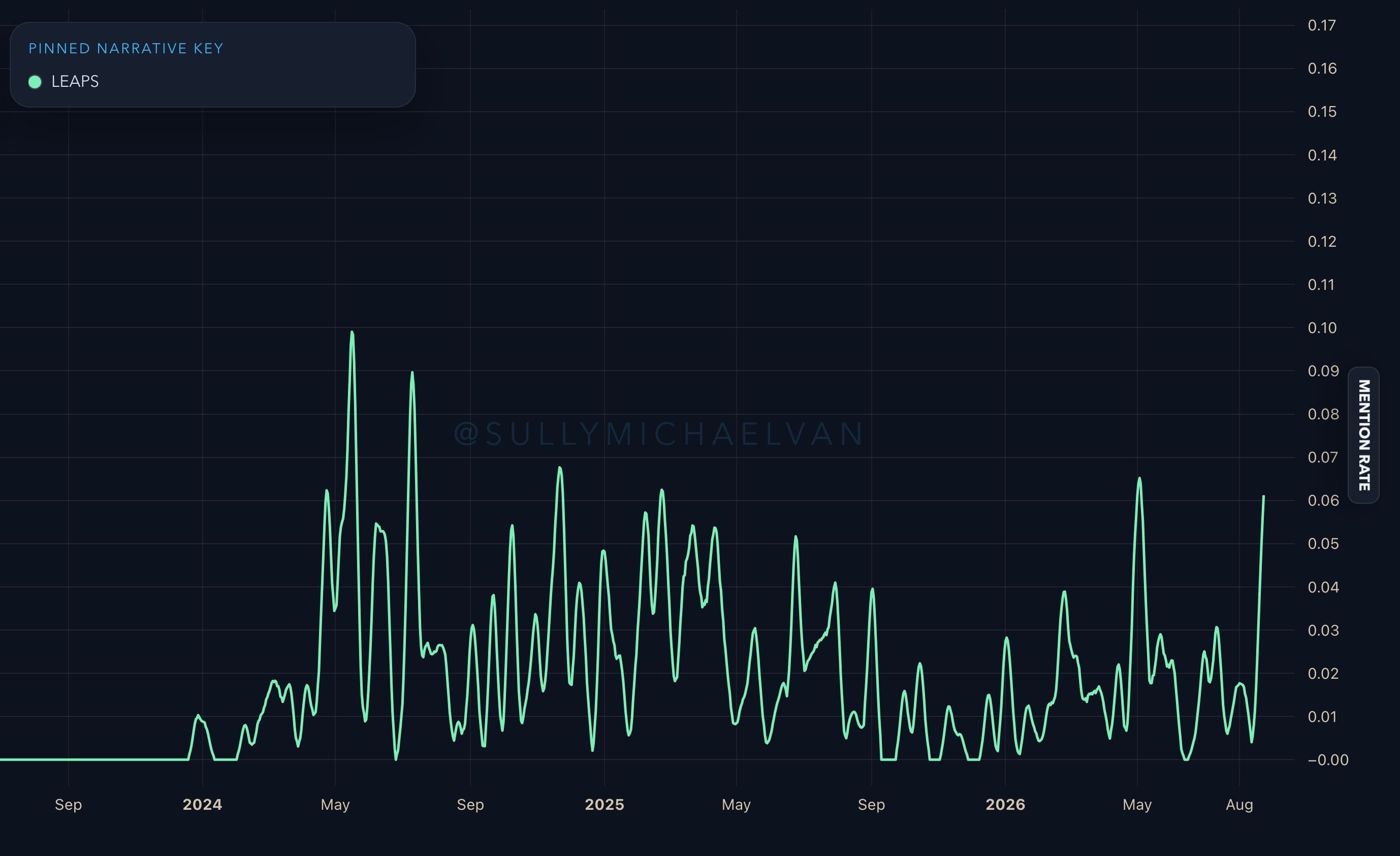
This chart shows how many people across the Bitcoin ecosystem are talking about LEAPS right now.
For those unfamiliar, LEAPS stands for Long-Term Equity Anticipation Security. They are basically call options (and technically puts too), with the nuance that they have an expiration date more than a year away.
This doesn’t necessarily give us the full context of these mentions, but it does show that people are either bragging about how well they’ve done with these securities or talking about entering into them. And as you can see, this has happened in other periods of Bitcoin’s history.
Because of this, I personally believe this is a pretty good analog to greed (we’ll get deep into the actual emotions stuff soon). I start with this because it was what scared me most about this rally. Every time I see somebody posting about options, something inside me feels like the top is in.
This is probably my most bearish finding, but as we'll soon explore, I think it’s just one part of the broader picture.
Last week in The Bullish Case for Boredom, I argued that we bored out almost all the hot money.
This could be the first sign of it returning.
Algorithmic bias makes this dynamic appear even more pervasive because screenshots of huge gains receive disproportionate attention. So a smaller number of successful traders dominate the perception.
This is one reason it’s often tricky to deeply understand market sentiment just by scrolling your timeline. Unless you’re deliberately cultivating these things, we often see the most extreme examples.
But guess what?
I've got good news for you.
I’m not studying your timeline.
I’m studying the broader ecosystem. So let’s look even deeper at the Bitcoin community's current psychological state, and why this greedy behavior at the margins doesn’t scare me in the broader context.
What Does Disbelief Look Like?
Before I started looking at my charts and querying my database, I asked myself a question.
What am I expecting to see in the data this week?
And there was a single thing that I was watching for more than anything else.
Excitement.
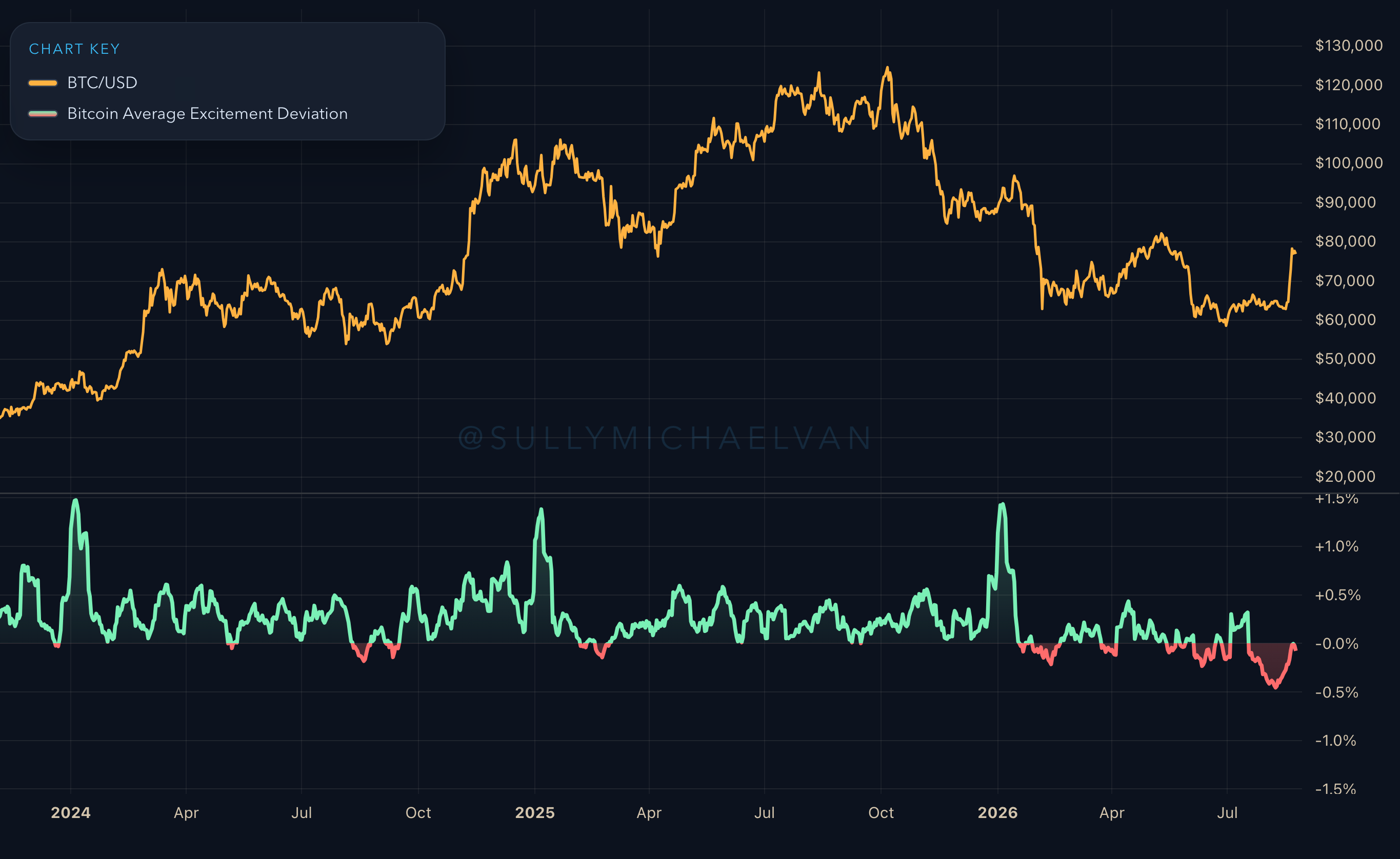
A couple of reasons for this. For starters, excitement is one of the emotions most tightly tied to volatility. And since this is one of the most rapid upturns in Bitcoin’s history, I thought we’d see a massive spike of it.
I was wrong.
Additionally, excitement is a short-term-looking emotion. Where something like optimism looks way out in the future, excitement’s about the here and now. People are convinced something is going to happen, and typically something good.
We saw almost no excitement before this rally, and even with it we saw shockingly little.
This is one of the primary reasons I do think it is a disbelief rally.
Excitement and engagement are quite low.
I think one thing making this confusing for people is that moods are up from where they were a week ago, but this is nothing like the emotional environment of the other peaks on the chart above.
We’re just beginning to exit the most boring periods of the last few years in Bitcoin.
People were checked out (not to mention all the infighting).
This is not us getting euphoric.
This is simply just us not hating one another anymore.
It’s one small bit of reprieve from the pain.
Next, let’s approach the question from another perspective and examine which groups are beginning to reengage.
In my piece, Fading the 4-Year Cycle, I made some bold predictions that have panned out (so far). In it, I predicted we’d see longer-term OGs start to shift their mood before the Plebs.
Which is exactly the shift that’s starting to happen.
OGs vs Plebs
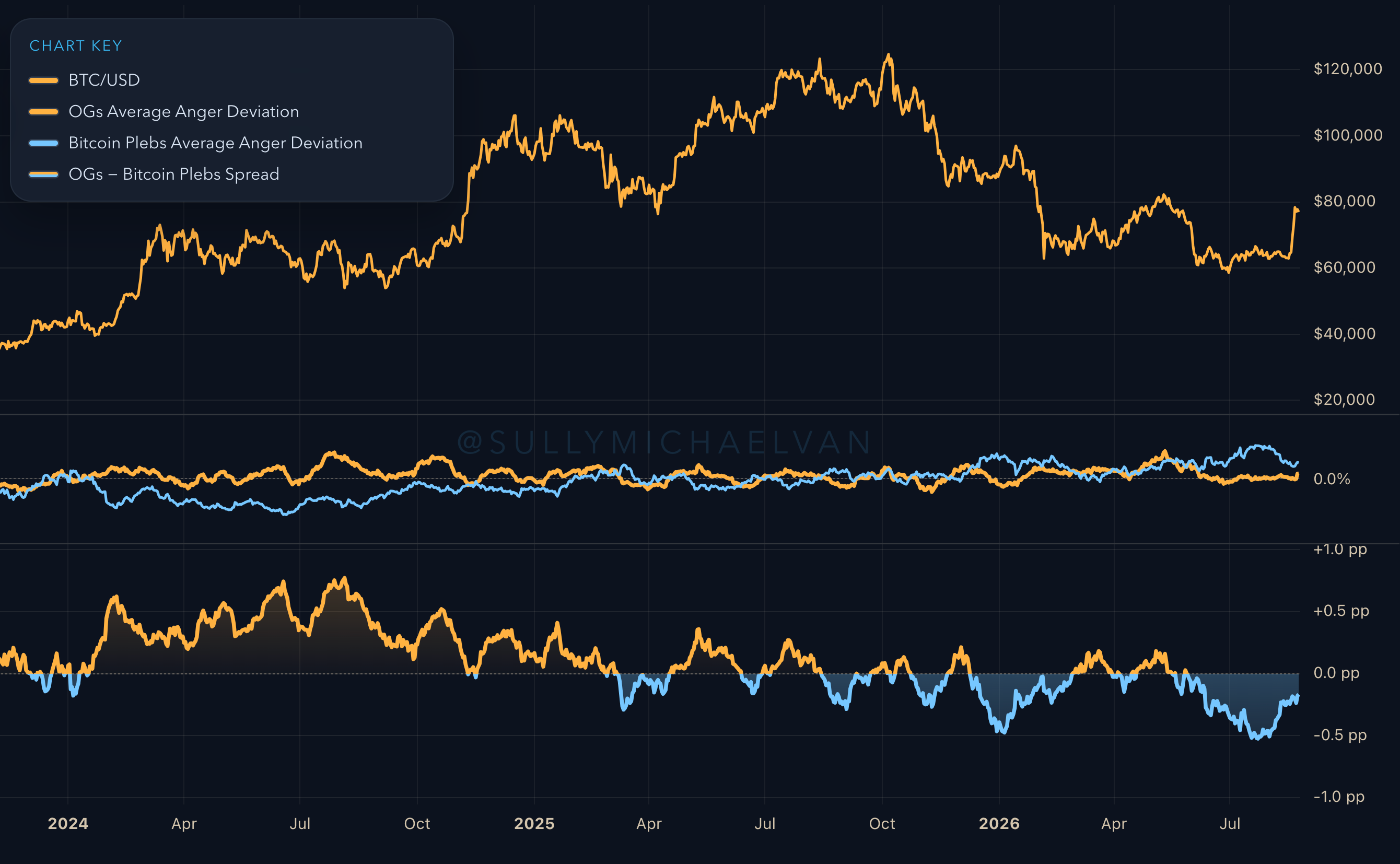
These two groups are particularly interesting to compare because they have very different levels of market experience.
The OGs have obviously been around a lot longer. So during inflection points, I think it’s particularly interesting to see how these two cohorts respond differently.
In short, the plebs are still pissed.
This group has been substantially more angry for a long time. You’ll note that over the last two years here, in the first half, the OGs were angrier (perhaps some of this was caused by the treasury company trade). In the last half of the year, the plebs have been much angrier.
This came to its crescendo around BIP-110.
I share this not to dunk on one group or the other, but because it helps us understand the social reaction to the current pump a bit better.
When you’re angry, and something good happens to you, you’re less likely to see it as good and more likely to pattern-match and see how it could be negative.
Emotions can poison our logical thinking, none more so than anger.
So the fact that we’re in one of the angriest regimes in Bitcoin’s history, I think it’s making people see some of the positive things that are happening right now in a negative light. And I think that plays a role in why people aren't convinced this is a real rally.
“But Sully, maybe people have just stopped posting?”
That’s a good theory, and I expect to see this too, but it’s actually not what’s happening.
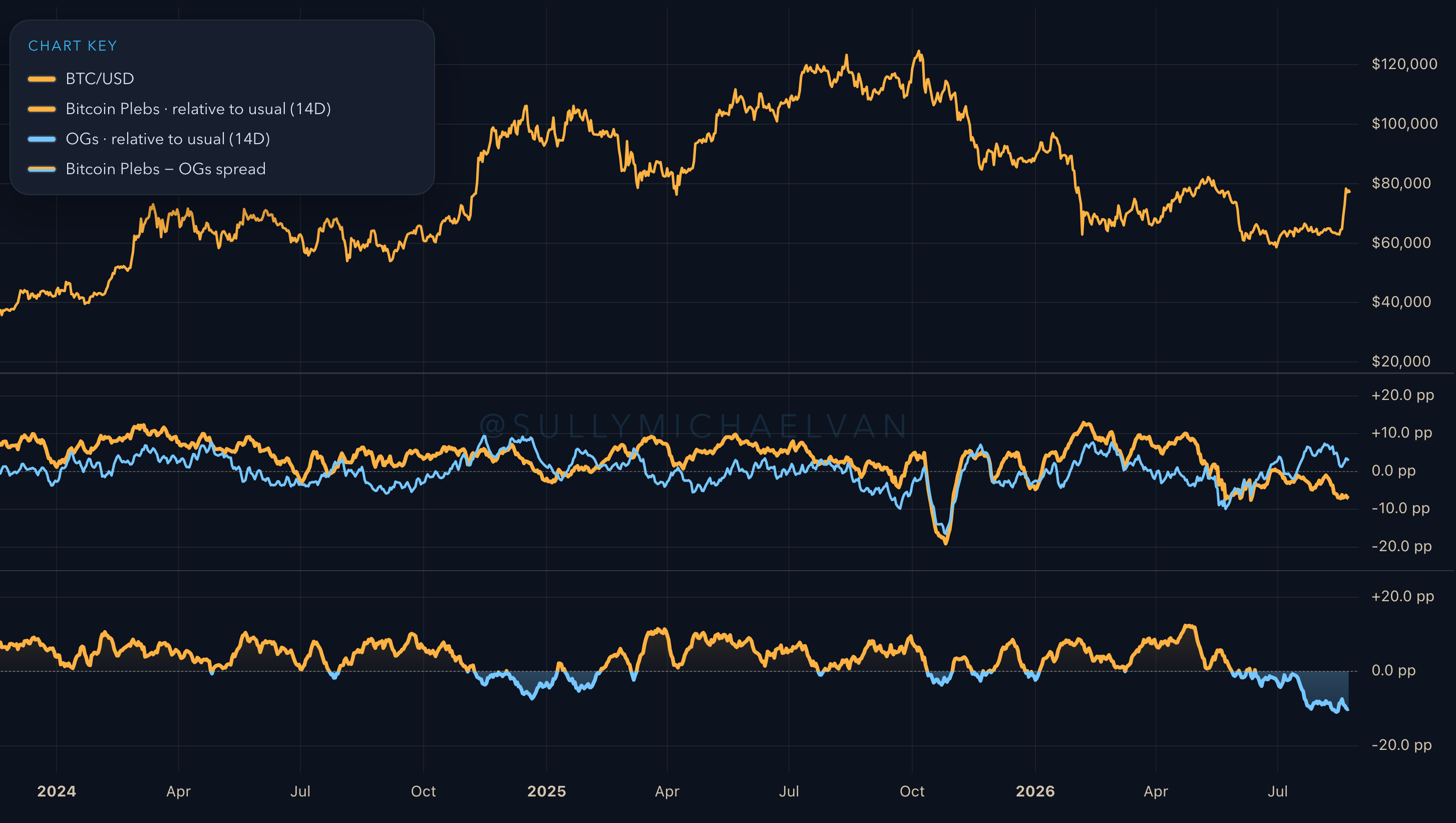
This chart shows how often each group is posting relative to their baseline.
And again, surprisingly to me, I was expecting to see a much bigger fall-off here.
Engagement and activity in general are down, but what I found most interesting was that pleb activity has been decreasing the fastest. And the OGs are gaining interest again.
If you are a long-time reader here, you’ll note that the OGs in particular have had an increased mind share with things like AI trade. So it's fascinating that they’re interested in the Bitcoin space again.
“Cool chart bro, but what does this tell us?”
I view each of these things as contextual.
No single data point can tell the entire story here.
But we are not seeing some mass influx where everyone is posting again. Interest is up, but the newer accounts are still much more checked out than OGs.
The experienced cohort is beginning to reengage while the less experienced cohort continues withdrawing.
Closing Thoughts
Most of the data I’ve shared here did not align with my personal expectations.
So many of these observations were counterintuitive. The things I expected to see in the data (excitement, optimism, higher engagement) simply were not there.
Despite the largest weekly Bitcoin move in dollar terms, people still aren’t super interested. And newer retail participants are nowhere to be seen, and some newer Bitcoiners are checked out or convinced we’re not done with the bear yet.
Again, we’re dealing with market psychology here, and none of this is structurally guaranteed. But these are precisely the things that you would expect to see during a disbelief rally.
So despite my contrarian bias to fade the volatile price move, I’m taking this one quite seriously.
P.S. If your work involves understanding the psychology of a particular market, audience, or investor base, feel free to reply to this email. I’d love to hear what questions you’re trying to answer and see whether this kind of analysis could be useful to you.
Hurt people hurt people and like you said angry people stay angry. Wonder if it will take Bitcoin getting to 100k to change their mood. They've had to endure being in the dumpster while people kept throwing their trash on top of them for a while. Wonder if anyone has created a Peter Schiff indicator.