
Fading the Four-Year Cycle
Let’s imagine what it looks like if Bitcoin’s most durable narrative finally breaks to the upside.

Many Bitcoin analysts have lost their credibility by claiming the four-year cycle is dead.
It’s a bad look.
Time and time again people think they are smarter than the crowd, and that Bitcoin market psychology has fundamentally shifted.
Time and time again they’re proven wrong.
It’s a terrible idea to publicly make predictions around this topic as there’s almost no strategic upside for the author and, by posting it, they run the risk of forever staining their reputation.
So without further ado… here’s what I think it’ll feel like when the Bitcoin four-year cycle inevitably dies.
“Bold dude.”
I know. I know. But this is not me digging in my heels and saying that the four-year cycle is gone tomorrow.
I don’t believe that.
Despite the declining impact of the halving, the four-year cycle remains one of the primary stories that people in the broader crypto ecosystem use to conceptualize price action.
What I do believe is that this narrative will eventually collapse, and now that moods are down and people are infighting I think it’s the perfect time to consider how that could be quite bullish.
See, most people don’t discover Bitcoin by studying the protocol.
Most of us saw the number going up, decided to look at the orange coin a bit more deeply, and then got exposed to whatever story or narrative is trending in Bitcoin at that point in time. Depending on when that was, you might have heard about peer-to-peer electronic cash, digital gold, inflation hedges, or digital property.
But one narrative eventually reaches nearly everyone who has been around Bitcoin.
The Four-Year Cycle.
The halving mechanism has existed since the very beginning, so it made intuitive sense that from a supply/demand perspective the influence of the halving on price would be reduced.
It follows that the halving’s marginal influence on price would slowly decrease over time until the four-year cycle ceases to exist.
A lot of people claimed that it would.
A lot of people have been wrong.
This story still continues on today and it’s become entangled in other (more structural) narratives like liquidity cycles and the presidential cycles. And because of this, it grows stronger. Each time this cyclical dynamic plays out more people anchor to this narrative.
That’s why I’m writing this.
Because narrative/sentiment data provides us with a unique way to look at narratives just like this one.
The four-year cycle is no longer some technically driven protocol principle. This thing is a story with a life of its own. A story that continues to propagate based on little more than human psychology and narrative momentum.
“Well dang, Too bad it’s only sentiment and vibes now and that we can’t study it.”
Skill issue.
We can study it.
Let us begin by quantifying some of these vibes, and we’ll wrap up by imagining a hypothetical scenario of what it might look (and more importantly feel) like when the four-year cycle narrative finally dies.
Note: Paid subscribers will find a 23-minute video breakdown and four additional sentiment charts at the end of this piece.
An Annoying Narrative
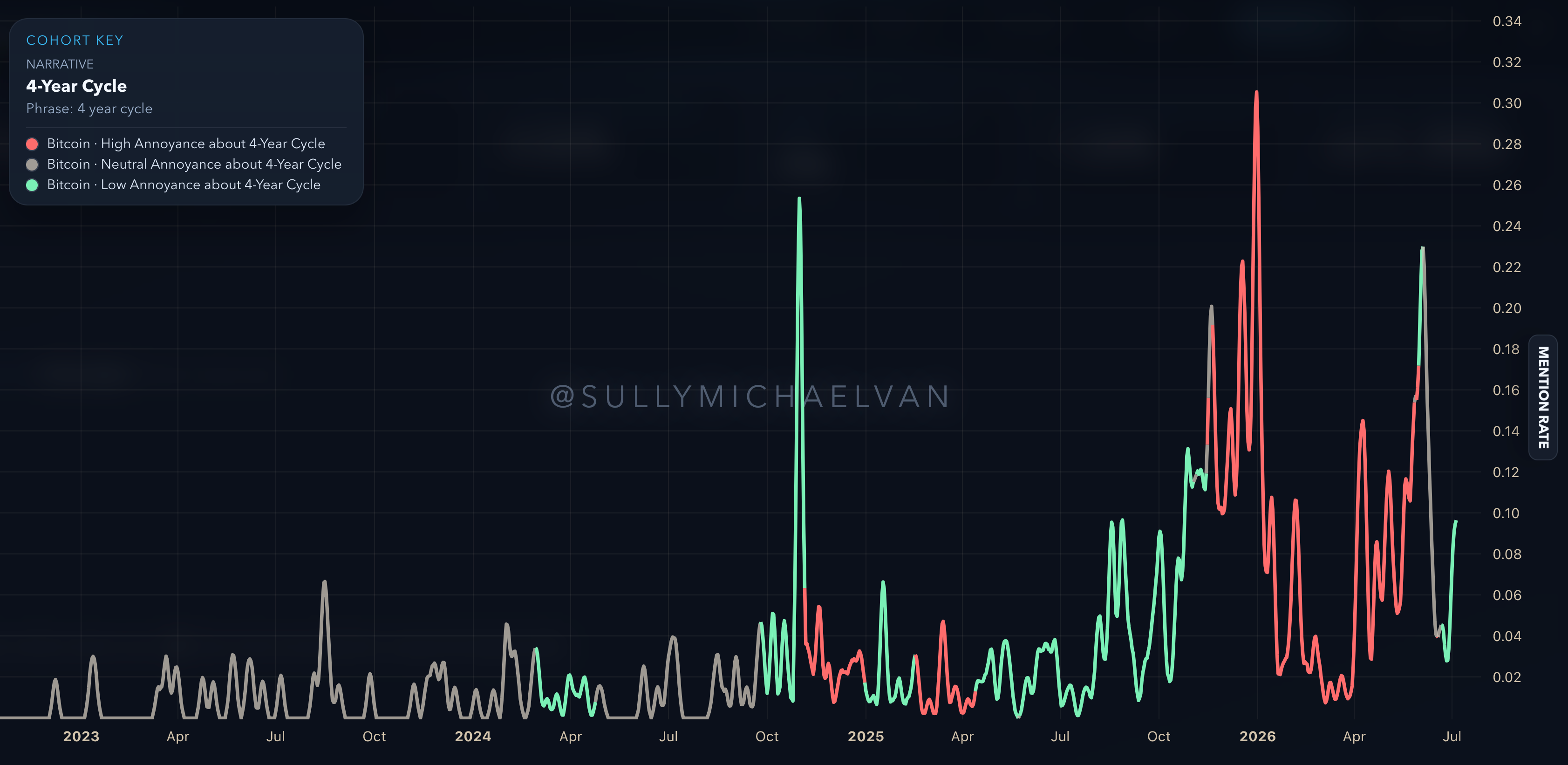
One of the most interesting dynamics of the four-year cycle narratives is that it’s contextual.
It’s not always bearish.
It’s not always bullish.
Many narratives in the Bitcoin space spread like wildfire, get latched onto by the masses, and then die all within a short span. That’s very different from what we see with the four-year cycle.
It’s almost always in the background, but it does see increased emphasis during specific time periods. You can visualize this by looking at the mention rate of Bitcoiners talking about the “four-year cycle” on the chart above.
This is what makes it so interesting compared to other narratives.
Ironically the “four-year cycle” narrative, is in itself… cyclical.
In times like 2023 (when price was beginning to rise after a prolonged bear market), this narrative is latched onto as a reason why the orange coin is likely to go up substantially higher in the near future.
Bitcoin bulls wanted the narrative to play out.
In times like October 2025 (giant green spike on the chart) many people were talking about how the four-year cycle was dead now because of the persistent bid by Bitcoin treasury companies.
Bitcoin bulls wanted the narrative to die.
This is at the core of the idea I want you to think about with me through this piece.
Bitcoin is made up of stories, those stories change, but depending on our emotions and the broader state of the Bitcoin market the crowd is more/less likely to believe in these stories that align with what it desires.
Inevitably (over a long enough timeline) the four-year cycle will die.
So if you had to predict how/why it would finally die, what kind of things might you think about?
What kind of environment might precede the death of this narrative?
What signs could a sentimentally savvy person look for?
Are these signs happening now?
To get to the heart of this I think we need to first understand how much emotions are correlated to narratives.
Narratives Are Downstream Of Mood
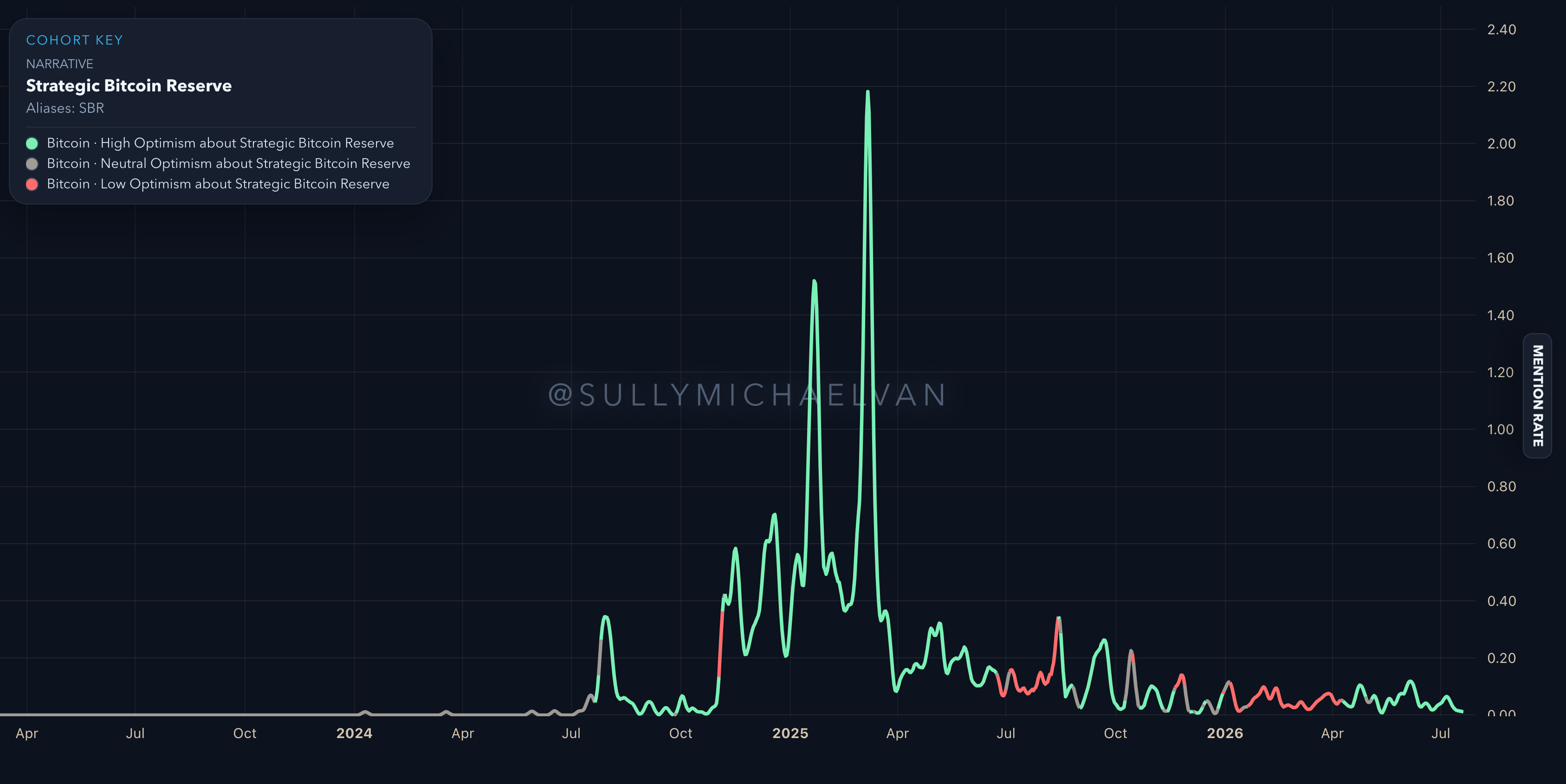
People following this work for a bit will know that I love thinking about the Strategic Bitcoin Reserve narrative.
“That’s lame. You shouldn’t rely on the government to come in and pump our bags.”
Agreed.
That’s not what we’re going to talk about here today.
My (or your) thoughts about it are not important right now. I’ve brought it up because it’s one of the best illustrations of this idea. The most optimistic periods in Bitcoin’s recent history roughly align with the highest mention rates of the Strategic Bitcoin Reserve.
This is not a coincidence.
When moods are euphoric and optimistic people don’t think clearly in predictable ways. During these mood regimes people overbuy bullish narratives and extrapolate them far out into the future.
The inverse happens in angry/fearful regimes.
People underweight positive news.
People think the bad stuff is going to happen tomorrow.
Currently, we sit in one of the angriest and disapproving mood regimes in Bitcoin’s history.
“Ok, so people are angry. Are you just telling us to do the opposite of the crowd? That’s easy.”
Bullshit.
Everyone thinks they are immune from the moods of the crowd.
Everyone thinks that their sources and algorithms somehow insulate them from the influence of market sentiment… but let me let you in on a little secret.
Everybody else also thinks this too… and everybody is wrong.
We all like to think we are immune from the influences of our internal emotional state, while very few of us actually are. Everyone is emotional. Even people with incredibly high IQs are influenced by emotions, they often just orchestrate more complex stories on top of their underlying moods.
One of the better examples of this is Sir Isaac Newton, who despite being one of the most brilliant men in all of history suffered severe losses in the South Sea Bubble.
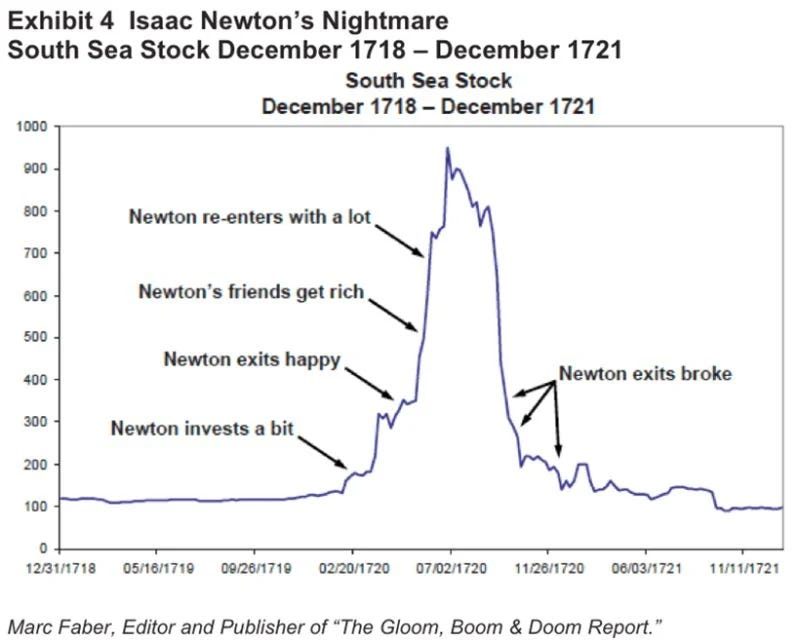
That’s where I think this data can prove to be quite useful.
By understanding the current emotional regime we are able to understand the kind of biases the market has. But (arguably just as important) we can understand the biases we might feel drawn towards.
Bitcoin is down now, so it’s really easy to forget just how enthralling that feeling of euphoria can feel.
And at some point in the not-so-distant future, Bitcoin will inevitably run up aggressively and you’ll no longer remember what it was like to live inside of your current emotional state.
“You cannot say with certainty that Bitcoin will experience euphoria again, what if the market has fundamentally changed?”
That’s the exact kind of thought that pops up when price is down, vol is low, and people don’t think there is reason for hope.
So yes, this all sounds very simple.
But it’s far from easy.
There is a good reason almost no one actually sells the top and almost no one buys the bottom… and it’s not for some hyper-logical reason.
It’s because of emotions and human psychology.
If you are here reading these words, you’re likely much more aware of this than the average person, but none of us are completely immune.
The value of this data, then, is not simply knowing that the crowd is emotional, but identifying when emotion is driving the narratives more than something structural.
Which brings us back to the four-year cycle.
When to Fade the Four-Year Cycle
So now let’s take this logic one step further.
Are there specific times where it is more or less “safe” to believe in or reject the four-year cycle.
I personally believe so.
When price started to flip and gain some positive momentum in 2023, hope began to blossom and many people began to think about the four-year cycle in a positive manner again.
Believing in the four-year cycle in this scenario (in an optimistic manner) is a much different thing than believing that “the cycle isn’t over because we haven’t seen the euphoric blow-off top yet” in the fall of 2025.
The former was after a huge amount of people were flushed out. The latter narrative popped up after Bitcoin had already run up 500% off the bottom.
We cannot predict the markets.
There easily could have been a situation where some wildly bullish news came out, retail euphoria ran wild, and we had the same euphoric top as previous bulls. But the higher the price goes (and the more desperately retail wants price to pump), the more dangerous it becomes to be bullish.
Using the cycle as one reason to expect a recovery in 2023 was, in my opinion, much less risky than relying on it to guarantee another euphoric move after Bitcoin had already risen roughly 500% from the bottom.
The emotion of “desire” is particularly useful here.
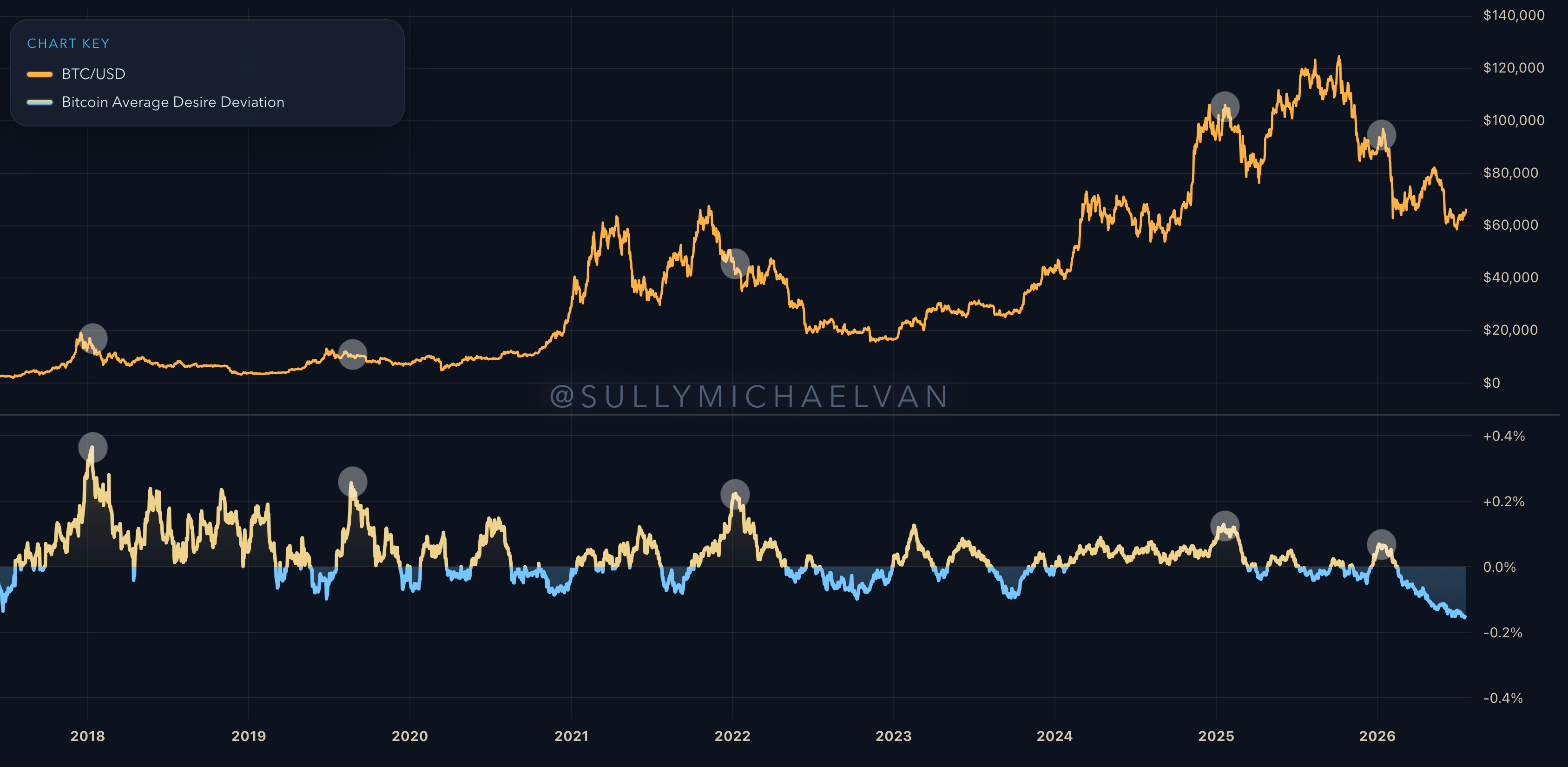
You can see that when the masses simply “desired” for the price to go higher, those were some of the riskiest times to buy Bitcoin. On the above chart I’ve highlighted five historical examples where high desiring language wasn’t the nail in the coffin for the bulls. If you’d like to understand why this correlation exists at all, I’ve written about it extensively over in Three Surprising Sentiment Signals.
“Cool charts bro, but we are nowhere near a euphoric bull market. WTF are you talking about top signals for?”
Because the exact same dynamic is happening right here and right now.
It’s just inverted.
Near the top, many people needed the cycle to deliver more upside.
Today, many people need it to deliver more downside.
The Market Owes You Nothing
In early stages of Bitcoin bull markets people start to believe in the four-year cycle again. It’s persistent, it’s around, but it’s usually not the central story.
Narratives like the Strategic Bitcoin Reserve and speculation around MSTR being included in the S&P all popped up in 2024 and persisted through most of 2025.
But towards the end of 2025?
There were certainly some bullish stories remaining, and I can understand why it’s hard to fade those narratives when treasury companies and ETFs were buying massive amounts of Bitcoin.
It seemed like the machine would just keep on running.
The most dangerous version being the following statement:
“The top cannot be in because the cycle has not delivered its final euphoric move yet.”
Bitcoin must go up, because Bitcoin always goes up at this point in the cycle.
During both tops and bottoms people typically make similar mistakes:
Near the top, they delay selling because the cycle owes them more upside.
Near the bottom, they delay buying because the cycle owes them more downside.
The last two completed cycles found their bear-market lows roughly 29 and 30 months after their respective halvings. Apply that same timing to the April 2024 halving and the cycle model points toward a bottom sometime late October 2026.
That is where the current expectation comes from.
Right now price is down nearly 50% from the highs, but because we haven’t reached lows seen in last cycles and it’s not yet October 2026 (when we are apparently pre-programmed to bottom) the bear simply cannot be over yet.
There have been many negative stories during this time period, but here are a few:
The bottom cannot be in because the cycle has not delivered its final washout yet.
We’ll bottom in the fall because the four-year template says we should.
Bitcoin has downward momentum, don’t fight the trend.
In a way, I agree with them.
It can often be dangerous to fight against the psychological momentum of the crowds.
But at the same time, this is a self-referential narrative feedback loop that some people (specifically those in the crypto markets) build their entire thesis around.
It’s easy to believe the four-year cycle is dead when that’s what you want to happen and the price is rising euphorically.
It’s just as easy to believe the four-year cycle is inevitable when price has been falling for months and the calendar is moving toward the exact window where the cycle model says the low should arrive.
These environments feel completely different, but psychologically they are mirror images to one another.
In both cases, people extrapolate the recent price action and embrace whichever version of the cycle confirms what already feels obvious. Near the top, the cycle must be dead because the upside feels unstoppable. Near the bottom, the cycle must still be intact because the downside feels inevitable.
If there was ever a time to fade these narratives, it is when price action makes them feel the most certain.
Which brings us to the fun part.
What might it look like if one of the oldest and more persistent narratives in the history of Bitcoin were to collapse to the upside?
A Narrative Unwind
There are a lot of different ways the four-year cycle narrative could die.
Perhaps we chop around $58k for a few more years and the narrative dies as Bitcoin becomes a stablecoin?
Perhaps the AI doomers are correct and we see total economic collapse and we just melt lower for another year?
But bear with me for a moment, because I think now is the perfect time to allow ourselves to think about bullish potential futures.
We’ve had nine months of downward price action, and many people have forgotten what green candles feel like. So let’s explore this. And you have my word that we’ll do the exact opposite exercise when things get bullish.
And after all… people are pretty annoyed right now.
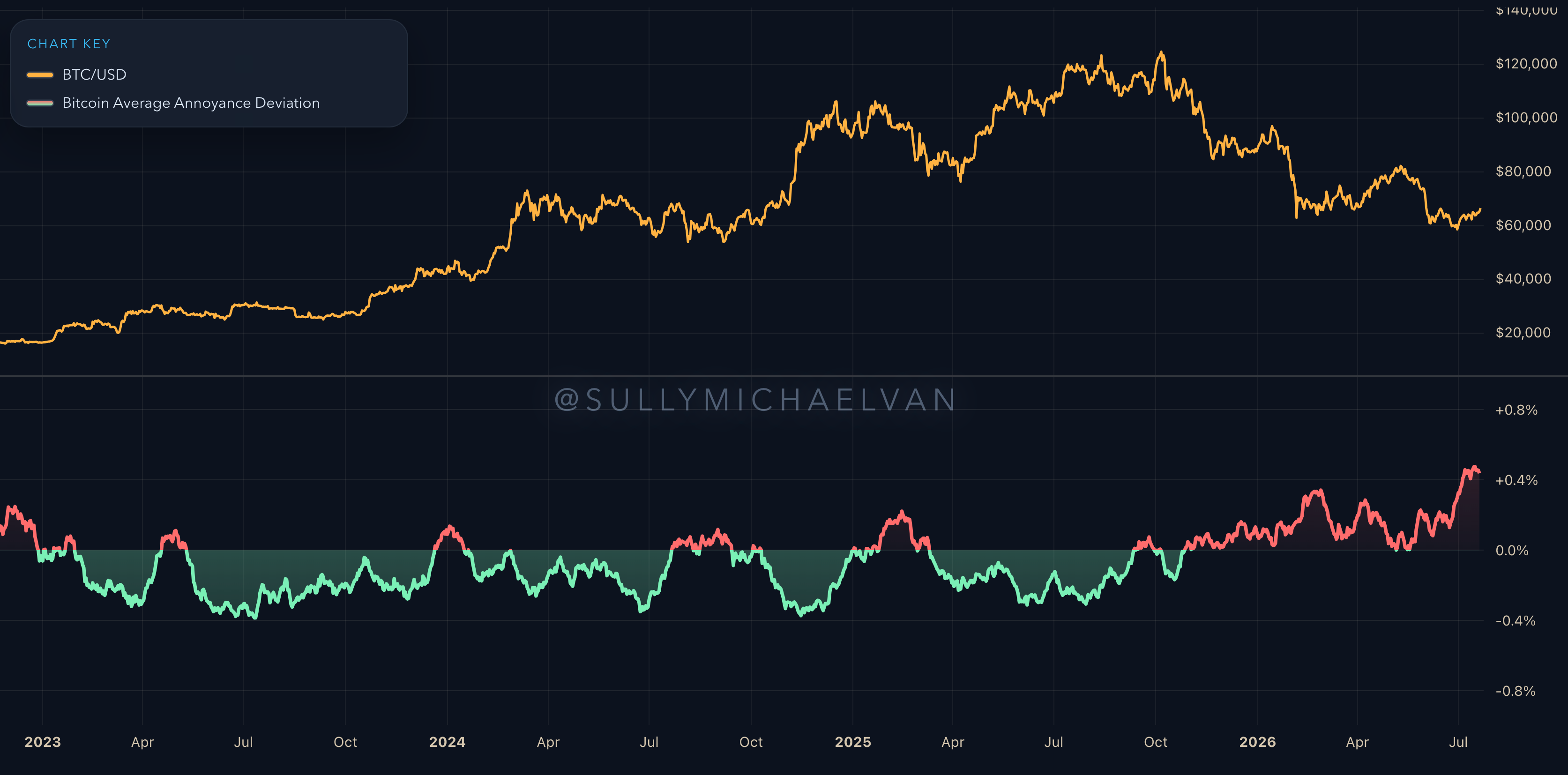
And it’s during these annoying times that it’s historically more lucrative to be contrarian and optimistic.
So let’s allow ourselves to hypothesize what it might look like if we were to “climb a wall of worry” and experience a narrative unwinding event.
What does it look like after narrative headwinds rapidly shift to narrative tailwinds?
Let’s let ourselves imagine.
But again, I’d like to do an exercise to hypothetically think about what it could look like when a narrative rapidly reprices.
“Bro, we get it. You can stop with the hedging and qualifiers, just give us some bull fuel already.”
I’m sorry.
I don’t want to give you the wrong impression. Nothing in markets is certain, and I want you to deeply internalize that before I say what I’m about to say next…
We sit in the precise kind of market conditions that I would expect to precede a narrative unwind:
People are bored, annoyed, angry, and emotionally disengaged.
Many believe the traditional cycle bottom remains ahead.
Specifically this October/November.
Not because of something structural, but because of past pattern matching.
The BIP-110 debate feels like it has a lot of arguing still ahead of it.
Worries of a chain split.
Concerns some percentage of Bitcoiners will sell and leave.
Many people think we’ll have to endure a wave of MSTR forced selling.
Bad right?
But despite all of the malaise, many of these things are simply narrative headwinds.
“What in the hell are you on about now? Narrative headwinds?”
Well some headwinds are real, concrete things based on fundamental facts about the world.
Fed rate hikes? Strait of Hormuz closing? AI innovation?
These things are real, structural shifts in the world.
They can be headwinds for the market, but in a much more practical and pragmatic nature.
But the four-year cycle?
This isn’t structural.
It’s collective market psychology coalescing around a shared view of the way the world works. I would argue the other two (BIP-110 chain split and MSTR liquidation) are very real concerns, but heavily overestimated because of the amount of negative emotion present in the market and people searching for people to blame.
These kinds of headwinds are much different than their structural cousins.
So now let’s allow ourselves to think bullishly.
What if that price action turns?
“This is the kind of analysis you are resorting to? Hypothesizing that markets shift for literally no reason and then imagining what things will happen?”
Yup.
But we’re not doing this just because it’s fun (not gonna lie though, this is gonna be a little bit fun). We’re doing this because it allows us to understand what this kind of thing might feel like. It can help us to envision how quickly a narrative can completely unwind if there is nothing behind it other than crowd psychology.
So let’s explore this hypothetical bullish future:
Price finds positive momentum.
Optimism starts to increase (if history is an indicator, OGs mood will lead the charge).
Division starts to wane, people get more chill as price rises up.
The BIP-110 debate resolves gracefully.
It’s less catastrophic than many people predicted.
There may be a chain split, but it seems likely that it will be supported by only a small economic minority, with minimal impact on price.
Despite being tumultuous, Bitcoin becomes stronger as the community gains a deeper understanding of how consensus is won.
One narrative headwind dies.
MSTR isn’t magically liquidated.
STRC (likely slowly) goes back to par.
A second narrative headwind dies.
The four-year-cycle maximalists who remain sidelined start to see consequential price levels break and momentum form, making the move increasingly difficult to ignore.
The 200-week moving average around $64k continues to hold.
Short-term-holder cost basis around $69k gets convincingly broken through.
MSTR’s cost basis and the True Market Mean, both around $76k, get taken.
Price moves through $83k which places the average ETF buyer in profit.
Their narrative bedrock, the four-year cycle, then comes into question.
What if we aren’t pre-programmed to bottom in October?
What if I didn’t buy the bottom?
Nah, couldn’t be, we’re still below $100k…
It’ll go back down
It has to go back down.
We’ll for sure see another war or something, right?
Maybe I’ll get a lower buying opportunity with a black swan event…
Why did I bet such a large amount of money on some magical crowd psychology voodoo story?
What is wrong with me?
How did I mess this up so bad?
The world is complicated.
There are variables outside the Bitcoin market we are simply unable to predict that will surely play a role.
The thing I want to draw your attention to is how rapidly narratives can unwind, and how unusual our current position is. We sit below a ton of important technical and psychological market levels, while price action appears to be influenced by a large number of psychologically driven factors.
Let’s wrap this up with some closing thoughts, followed by one more narrative headwind that could rapidly turn into a tailwind.
Closing Thoughts ($100k)
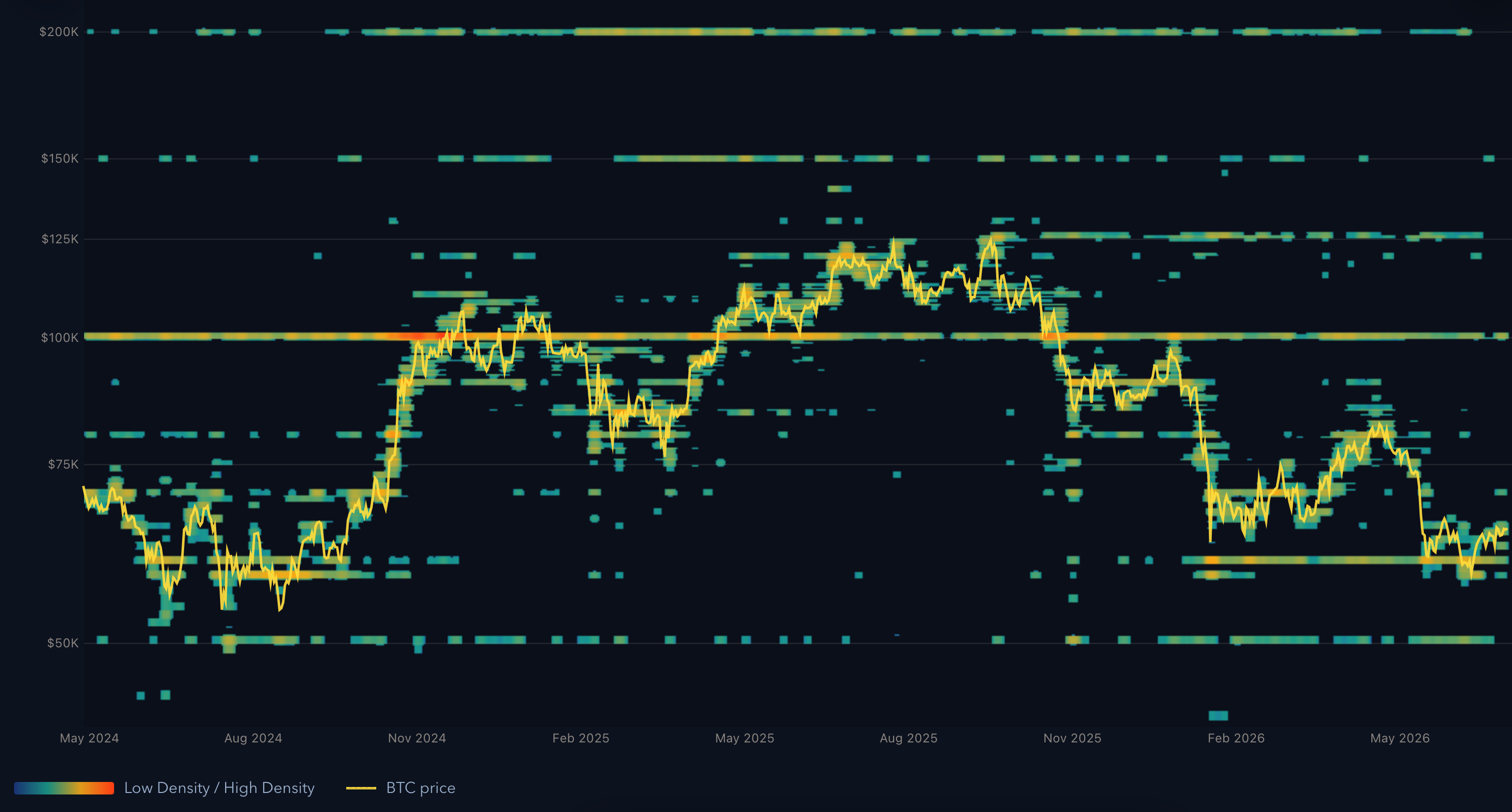
All of this happens while we also sit below one of the largest psychological levels in Bitcoin’s history.
This chart may look a bit chaotic initially, but it allows us to visualize something you’ve probably never seen before.
The yellow line is the Bitcoin price.
The heatmap behind it shows every price level Bitcoiners are talking about over time. The hotter the color, the more frequently that price level is being mentioned.
What’s novel about this is that it allows you to see where the crowd’s attention is clustering.
You’ll also notice a lot of chatter around current prices.
But the thing that sticks out to me is $100k. The line lights up constantly because it is a massive psychological target. This level doesn’t just have technical resistance, but it has narrative resistance too.
It’s a level people psychologically anchor to.
Interestingly, this level has been talked about less frequently as of late… as have price mentions in general. People are increasingly less interested in thinking about upside.
Do you understand what I’m trying to illustrate here?
There is no world in which I can accurately predict the future. All things in markets exist across a probabilistic spectrum. And, if anything, the fact I’m publishing this piece today slightly increases the odds the market gods decide to tank things just to make me look like an idiot.
But the thing that is incredibly unique about our current positioning is how many of our resistance levels are heavily psychologically driven or narrative based.
Bitcoin has already spent a considerable amount of time at every single one of the levels I’m discussing. So although there is so much baggage attached to each of them, these are not new price levels that market needs to digest for the very first time.
I can’t predict a war, I can’t political outcomes, and I can’t predict nation-state adoption (sorry, hedging again). But what I hope you take away from this piece more than anything is that banking your entire bullish/bearish thesis on a narrative might not prove to be the most resilient strategy if that narrative starts coming under increased friction.
Narrative frameworks can survive for years, but when they fracture they can reprice violently.
There is no market where it is more important to understand this than Bitcoin.
Because despite Bitcoin’s incredible degree of consistency and predictability as a protocol, the human psychology around it is extremely volatile.
If there were ever a time to fade the four-year cycle, now sure seems like a damn good time.
Going Deeper 🔒
This is where paid subscribers will find a 23 minute video where I dig further into the thesis, along with four additional charts I find particularly interesting right now.
The paid side also includes:
Subscriber-only videos featuring deeper analysis and exclusive sentiment charts.
Paid subscriber chat with early market mood updates and ongoing discussion.
Subscriber-driven analysis of Bitcoin cohorts, narratives, and phrases.
That’s all I’ve got for you folks.
Thanks so much for reading, stay bullish out there ✌️
P.S. I’m now offering bespoke narrative and sentiment analysis for businesses that want to better understand the moods, narratives, and psychology shaping their current and target audiences.
Shoot me a DM if that sounds useful.
Great stuff. I’m tortured by this (I say that in jest) feeling of the bottom must be near but who knows when and it definitely could go lower but it’s gotta go up eventually but what if it languishes for another 5 years but that seems so unlikely but but but
“Near the bottom, they delay buying because the cycle owes them more downside”
This one is more insidious than feeling owed more upside during the bull imho. Bearishness feels smart, smarter than gigabullishness does at least, which makes it even more blinding.
Great piece as always! I can’t wait for October if only to see these discussions resolve.