
Three Surprising Sentiment Signals
Bitcoin’s emotional signals are stranger, messier, and more useful than they first appear.

I wanted things to be simple.
I truly did.
When I first started digging through Bitcoin mood data, part of me was hoping to find some singular metric I could package up with a pretty bow that would tell me when the orange coin was looking extra bullish.
Unfortunately (but perhaps predictably), human emotions are not that simple.
Bitcoin sentiment is not one clean emotional line. It’s not just fear vs greed. It’s not just bullish or bearish. Bitcoin is a messy emotional system made up of different groups reacting to the same market in very different ways.
But despite my initial frustration, I realized I’d stumbled onto some incredibly valuable signals.
TLDR:
Excitement tells a different story based on who is feeling it.
Confusion can tell a different story based on the price trend.
When desire gets too high, it can mean buyers are already positioned and mostly hoping the market rewards them.
Instead of a big intro, let’s get right into the three correlations that completely captivated me. Then we’ll wrap up with some closing thoughts showing how each of these moods impacts our current market.
1. OG vs Pleb Excitement
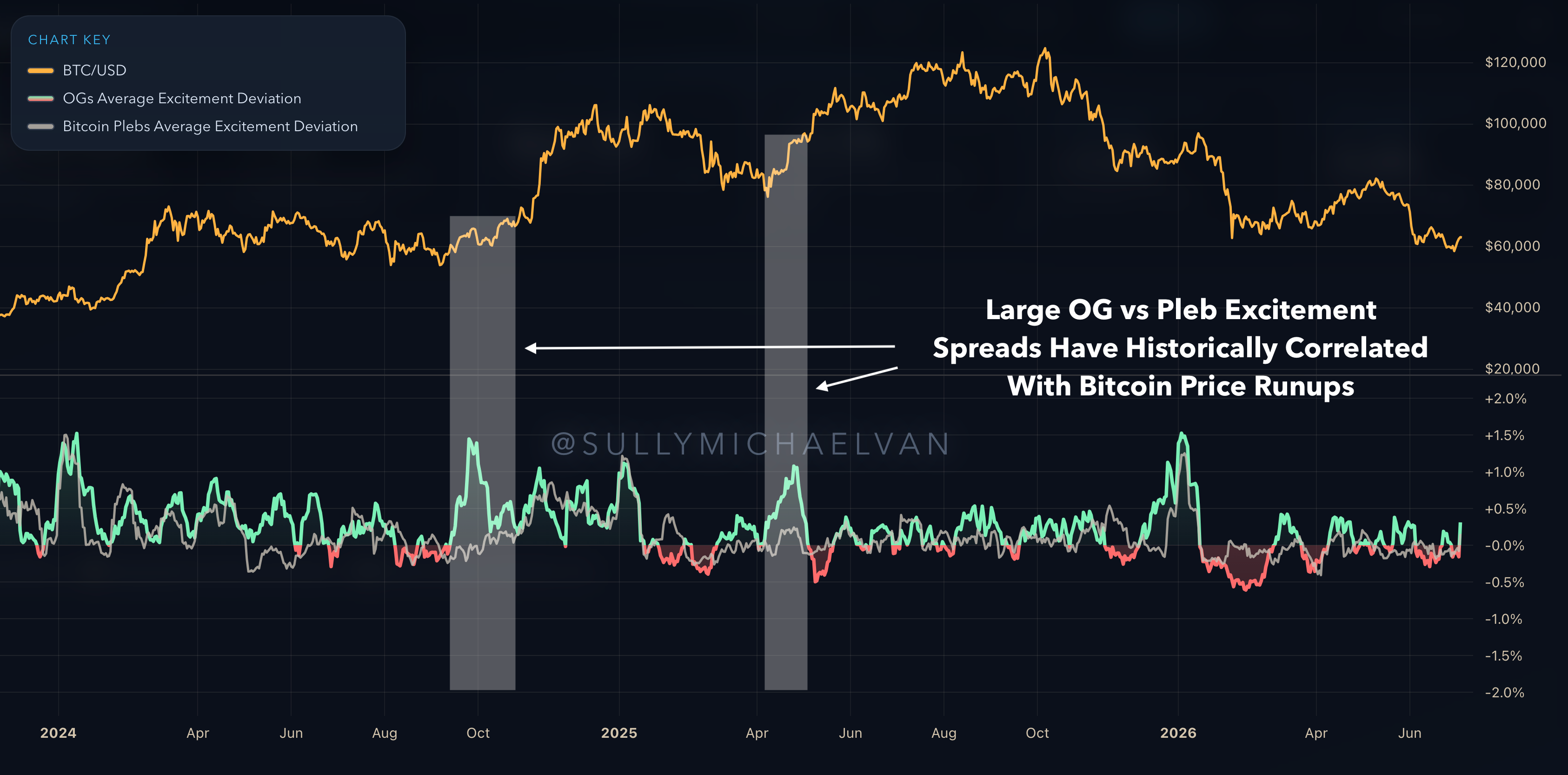
When I first started exploring Bitcoin sentiment, a trend immediately stuck out to me. The longer you’ve been in Bitcoin, the less variance people have in their emotions when talking about Bitcoin.
I wrote about this more thoroughly in Sentiment Volatility (Or How To Be Slightly Less Stupid)
If you’ve been into Bitcoin for a bit, this should be straightforward to understand.
I vividly remember learning about Bitcoin for the first time.
That period of my life was completely euphoric.
I was exposed to new ideas and many of my perceptions were completely flipped on their head… but even as I spent more time learning about Bitcoin, I was still completely oblivious to the realities of Bitcoin.
Across pretty much any domain in life, the more time you spend in it the better you get at it.
The same holds true with weathering Bitcoin volatility.
This might seem speculative, but you can actually see it quite clearly in the mood data. The longer people have been in Bitcoin, the fewer ups and downs they have in their moods.
This makes periods of time where OGs are significantly more excited particularly interesting.
In other words, excitement matters most when it comes from the group that is hardest to excite.
Pleb excitement is more reactive to price, headlines, and social momentum. OGs are usually harder to move because they have seen more cycles, fakeouts, hype, and crashes. So when the OGs get disproportionately more excited than Plebs it’s worth watching very closely.
The most stark example of this dynamic playing out is at the very end of the 2024 summer chopsolidation (thanks for the great narrative language James Check (Checkmatey)) where the OGs became significantly more excited than the Plebs as price started to break out.
This alone was a huge learning… but it led me to another I wasn’t expecting.
Humans are emotionally complex, and despite people saying that the vibes are “good” there is way more happening beneath the hood. Excitement isn’t the same thing as optimism for example. These two moods deviate more than you might expect.
“Dude, I’m not reading Bitcoin content to learn about human psychology, move on.”
I know, I know, but like it or hate it Bitcoin is massively impacted by human psychology, so understanding the nuances of it can actually lead you to have a more accurate view of the market.
And honestly, this one is fascinating.
Different moods have different relationships to time.
Excitement is more present-tense than optimism for example.
You can see this in the chart above where the excitement very rapidly peaks right around expected events and inflection points.
This makes sense as you typically are most excited for something as it gets closer. If you have a trip planned, it’s exciting when it’s months away, but the night beforehand you’re so excited that it’s hard to go to sleep.
Contrast that with optimism.
Optimism is a belief about the future, typically looking out over the projected path of life in front of you and how positive/negative you perceive it to be.
This might seem pedantic, but I actually think it’s quite practical.
Excitement spiking tells a much different story than optimism spiking.
The former is the crowd suspecting something good to happen very soon, the latter is the crowd looking off into the distance. Each of these are distinctly different signals. And this divide is amplified based on which groups are feeling it.
“Ok, so OGs are a higher signal group than Plebs, this isn’t that interesting.”
Nope.
Wrong takeaway.
Oftentimes the newer retail Bitcoiners are the highest signal group to track.
2. Pleb Confusion
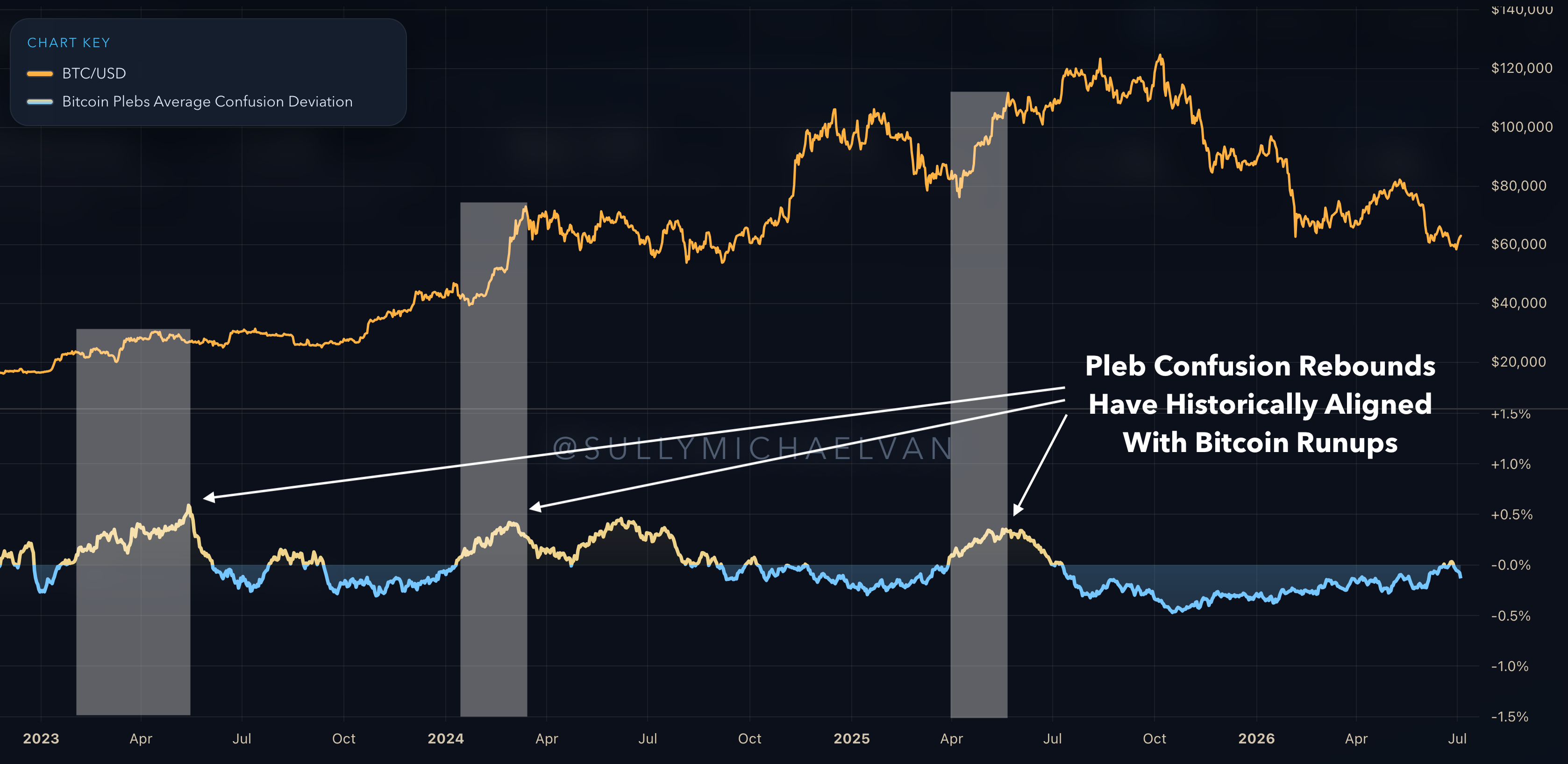
Confusion is definitely bearish… at least that was my assumption.
If people are confused, it sounds like something is broken. The market is unclear. The story is messy. Nobody knows what’s going on.
But this isn’t the case at all.
Confusion is not automatically bearish.
It’s not automatically bullish.
Confusion rapidly rising from suppressed levels and crossing back above neutral is historically correlated with price run-ups.
“Sweet lines bro, but what does this actually mean?”
Well, confusion is in large part, representative of when price does something the crowd wasn’t expecting. In other words, confusion is the emotion of questioning.
Low confusion is not indicative of the crowd magically transcending into profound levels of clarity. It just means the crowd is asking fewer questions than normal.
One way to think about it is:
High Confusion = More Questions = More Open-Minded
Low Confusion = Fewer Questions = Less Open-Minded
“So why Plebs?”
I didn’t start with a story to tell (as much as I do love telling a good story), I started with data. I looked at which moods had the highest levels of statistical correlation historically and am working backwards to contextualize WHY this trend may exist at all.
This was one of those trends that was too statistically sound to ignore.
My take is that newer Bitcoiners are usually more shocked by positive price moves than the older cohort. Where excitement by more experienced market participants is high-signal, watching newer retail participants think they have things figured out is also high-signal.
This is analogous to why onchain analysts look at long-term holders vs short-term holders. I’m applying that same idea to language/sentiment analysis. In onchain, the STHs are particularly interesting because they are more representative of newer actors in the ecosystem.
In other words, there is a big difference between a newer market participant getting confused and an OG getting confused.
But I think the most statistically precise takeaway here is that Pleb confusion is less about the absolute level and more about the inflection.
The interesting part is when confusion has been buried, starts moving higher quickly, and crosses back above neutral. This suggests that the story newer participants believed is starting to fracture.
Price moves first… explanations (not necessarily good ones) come later.
3. Desire
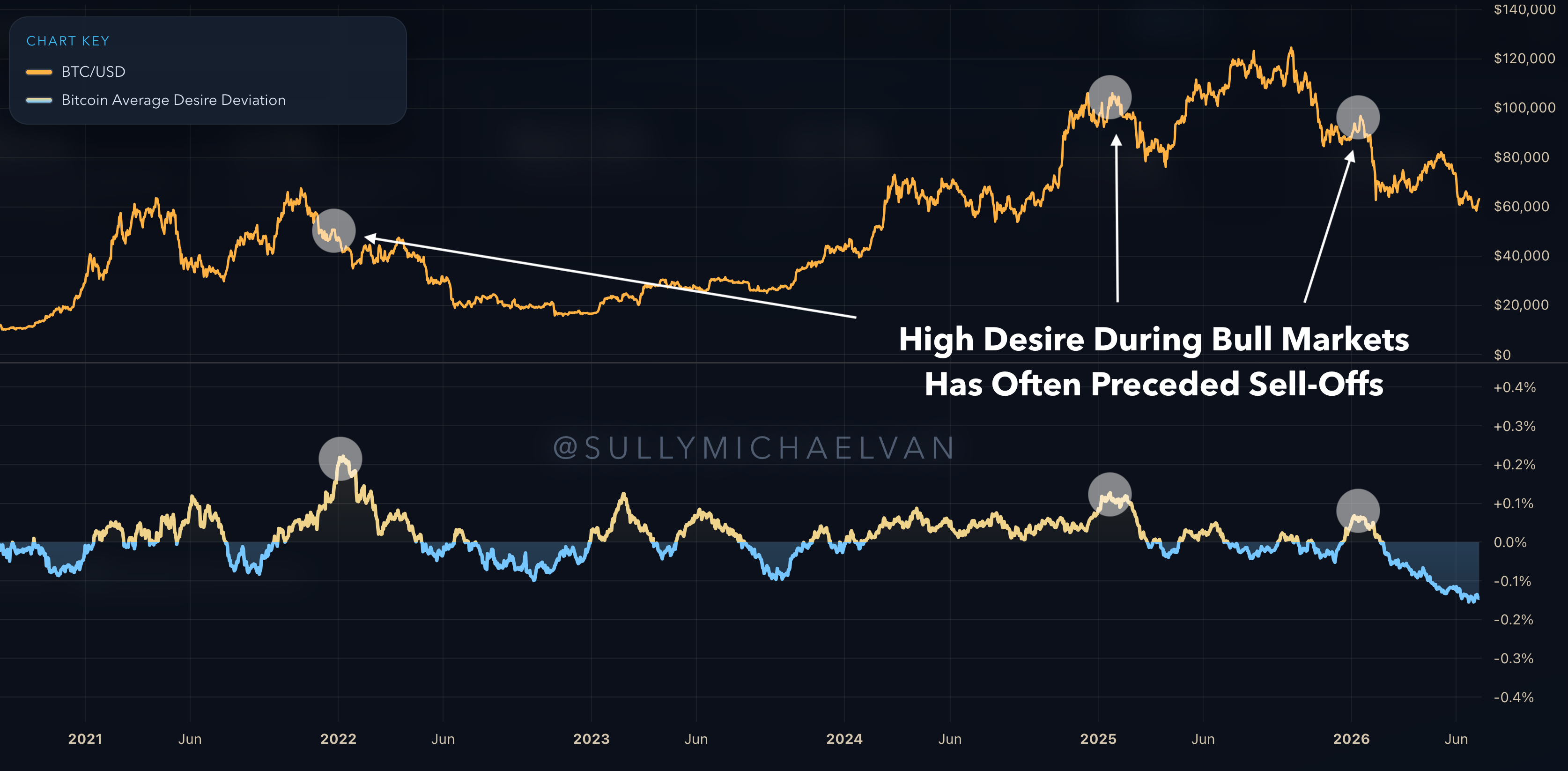
Excitement was pretty exciting and confusion got a bit confusing… so I’m really hoping this section will leave you desiring to learn more about the kind of things that are possible with sentiment analysis.
Speaking of sentiment analysis, if you’re enjoying this work (or my silky smooth transitions between long-form writing and self promotion) I’m building out a paid side for readers who want to understand Bitcoin market moods more deeply.
Early subs permanently lock in this intro rate while this work continues to develop.
“Wait… people are paying you to analyze how much “desire” people are feeling?”
Yes.
Yes, they do.
I’m aware that this all sounds incredibly strange when you first encounter it.
I thought so too.
And although there is no singular emotional signal that’s going to allow you to trade BTC on the daily with 100% precision (truly unfortunate, I know), I personally think these emotions have an incredible amount of value when zooming out and viewing the broader state of the market.
So let’s zoom waaaaay out and look at the emotion that baffled me more than any other.
Desire.
Where optimism is expecting good things to happen and excitement is anticipation that good things are about to happen… desire is wanting good things to happen.
This chart really blew me away the first time I saw it.
Desire often peaked before bull-market sell-offs.
Low levels of desire often aligned with fantastic buying opportunities.
The trend itself is interesting, but equally interesting is why this trend exists at all. There are multiple different ways to think about this mood, but at the core, I believe it has to do with the principles of human action (didn’t see that coming, did you Ludwig von Mises fanboys).
Much like excitement/optimism are intertwined with time, some emotions have a stronger grounding in human action. A good example of this is pride. To better illustrate this idea, let’s contrast it with desire.
Pride:
“We built this.”
“I’m proud of what our team accomplished.”
“We proved everyone wrong, we earned it.”
This mood often happens after a concrete action has taken place… desire is the opposite.
Desire:
“I hope we finally get it.”
“Please just let this happen.”
“I hope someone does something.”
I hope this comparison illuminates things a bit. Wanting something to happen doesn’t DO anything.
It’s cheap.
Just desiring Bitcoin to go up is much different than actually putting in the work and stacking sats. I think this lens helps to understand why desire shows up around tops.
Markets are fundamentally driven by economic action. Price goes up when someone decides to embed more of their economic energy into the market through the action of buying.
Desire is not demand.
Desire often shows up after action has already happened. People have bought, positioned, and taken the risk they’re willing to take. At that point, the remaining emotional expression is to wish that something outside of your control happens.
This is why high desire can be viewed as a warning sign. It may mean the existing buyers are already in, already positioned, and now mostly hoping the market rewards them.
When the broader crowd is out of dry powder and resorts to wishing the price was higher, it’s historically been quite bearish.
Concrete Takeaways
Unfortunately, things are not simple.
The more I study these moods, the less interested I become in finding one perfect metric to track.
All three of these sentiment signals hold incredible promise, but the more I study this the more I think the deepest value is finding where these signs fit into a broader framework.
Confusion, excitement, and desire all matter, but none of them matter in isolation.
They are contextual to the Bitcoin price and happenings in the ecosystem.
“Really dude, you’re going to be all wishy washy? I was promised some juicy market signals.”
Fair enough.
Here is my brief read on the state of each of these emotional regimes and where they sit today:
Pleb vs OG Excitement - Both cohorts are pretty bored right now. We are for sure not in one of those windows of time where the OGs are significantly more excited. This might not be euphorically bullish in the short term, but the market has been growing increasingly apathetic so far in 2026. Sounds bearish, but it’s a contrarian buy signal.
Pleb Confusion - The Plebs have had lower levels of confusion for over a year. We just started to trend upwards as they started asking more questions. Hypothetically (not formally predicting this yet), if we were to have a large upside move I’d expect for this mood to convincingly break above baseline indicating a large structural shift.
Desire - We are clearly nowhere near one of these high-desire regimes, instead, we are at the lowest levels of desire in the last five years. Traditionally these have marked fantastic buying opportunities.
I suspect you’ll be able to read between the lines here and recognize that I’m quite bullish currently.
I don’t believe this data is going to allow you to perfectly trade the Bitcoin market. But I do think this data could allow us a much more accurate view of the emotional state of the market in a way that could help us make better decisions that are less influenced by emotions.
Even if there isn’t a singular emotion that tells the entire Bitcoin chart with certainty, there is something I’m certain about.
I’m going to continue exploring the language of this market and learning what signals are hiding beneath the surface.
I hope you’ll join me on that journey.
Thanks for reading ✌️
P.S. I recently started doing bespoke narrative/sentiment analysis for businesses and individuals who want a clearer read on what’s happening in the Bitcoin ecosystem (including the narratives forming around their own companies or products).
Shoot me a DM or leave a reply if you’re interested.
Your a smart dude. 😎