

Everyone wants me to write about the BIP-110 fallout or the Coldcard drama… so naturally, I’m going to write about something completely different.
MSTR.
“But Sully, BIP-110 is the most important thing in Bitcoin.”
The price action disagrees with you.
While Bitcoiners were consumed by The Current Thing™, something subtle has been developing behind the scenes that no one’s talking about.
So that’s what I’m gonna cover today.
We’re going to dive right into the most interesting sentiment relationship I’ve measured to date.
TLDR: MSTR investors are now more convicted (and less fearful) than Bitcoiners broadly, despite MSTR suffering the deeper drawdown.
Without further ado, let’s get into the data.
Sentiment Splitting
I have a confession.
I’ve been building new ways to quantify sentiment data behind the scenes again. I truly can’t help myself, the ideas just keep coming.
This one is my new favorite.
It’s what I’m calling a “sentiment spread”.
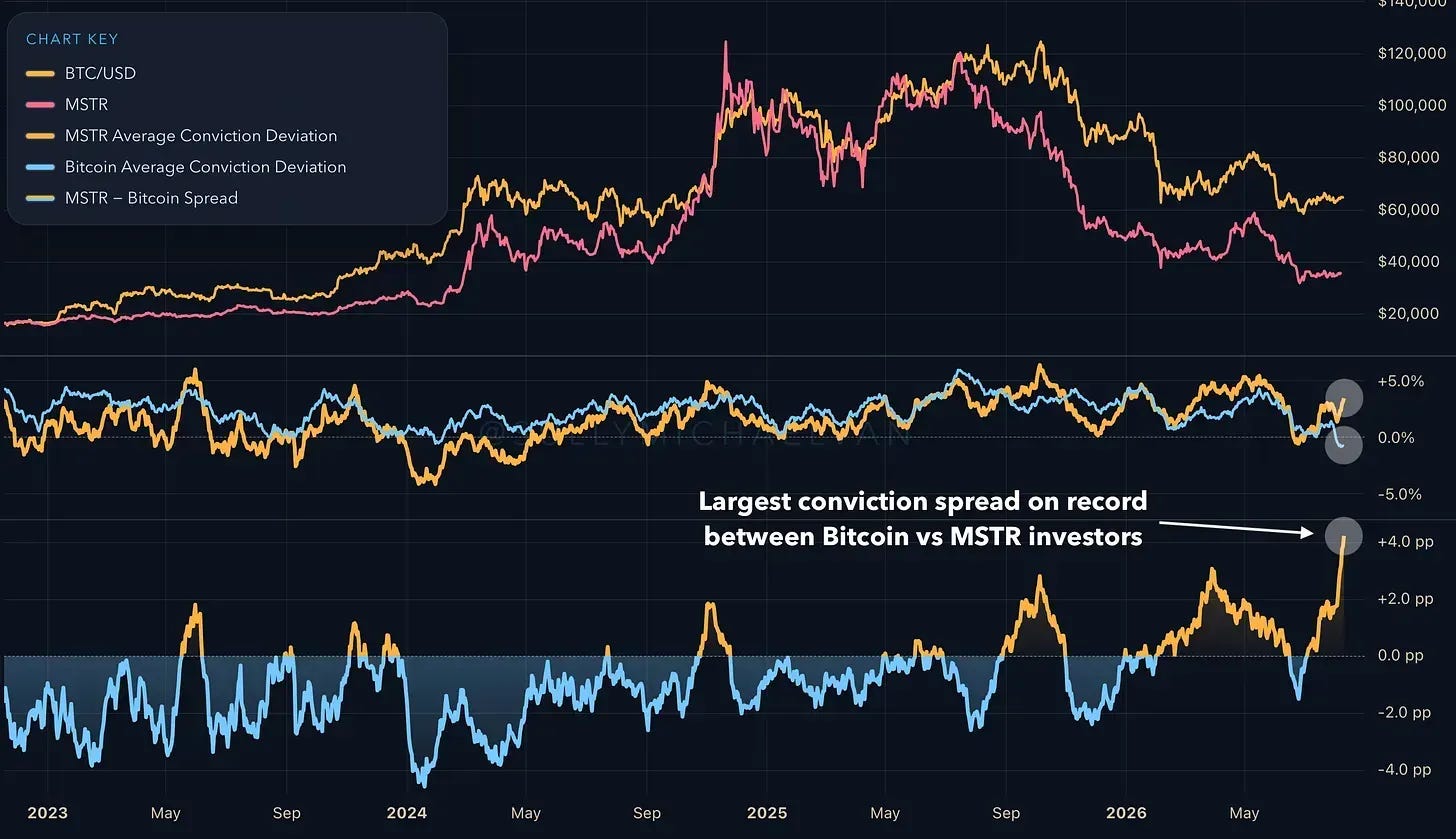
It measures the difference in a specific mood across two different cohorts. In this case we are looking at the conviction levels of MSTR shareholders vs Bitcoiners more broadly.
But there’s a lot going on, so let’s step through it together.
The top section shows both the BTC and MSTR prices over the last few years.
The middle section shows the aggregate conviction levels of Bitcoiners (blue line) and MSTR shareholders (orange line) over the same time duration.
The bottom line combines these and shows the space between them (the spread). So when it’s blue, it shows that Bitcoiners are generally more convicted than MSTR shareholders. When it’s orange, it shows that MSTR shareholders are more convicted than Bitcoiners broadly.
“Ok, cool share dude, but why should I care?”
Because it separates MSTR investor sentiment from the background emotional state of Bitcoin.
If conviction rises across both groups simultaneously, MSTR investors may simply be responding to Bitcoin. But when the two groups diverge, it tells us that something distinct is happening inside the MSTR shareholder community.
That’s exactly what we’re seeing now.
To demonstrate, let’s look at January 2024, when the blue portion of the spread was more pronounced than at any other point in the measured history. This coincided with the approval of the spot Bitcoin ETFs.
I was an MSTR shareholder around this time (still am) and I remember it vividly.
A widespread narrative emerged that spot Bitcoin ETFs would eliminate much of the reason to own MSTR. Investors could supposedly sell their MSTR and obtain cleaner Bitcoin exposure through products like IBIT. There was a lot of concern that there would be a huge sell-off as people dumped their MSTR shares for IBIT.
Well, that didn’t happen.
But it’s an interesting point in history through language data. We can now visualize the language each group was using during that period of time. MSTR shareholders used less confident language than Bitcoiners did more broadly. Their conviction levels (on average) were lower.
I mention this because it’s distinctly different from what we see now.
MSTR shareholders are much more convicted than Bitcoiners.
“If conviction was low before that run-up, does that mean price is about to tank?”
That’s not my takeaway at all.
In fact, when MSTR shareholder conviction spiked in October 2024 it preceded a euphoric run up, but this kind of simple pattern matching misses all nuance.
Conviction is related to stories we tell ourselves.
It’s related to the current market narratives.
Humans are more convicted when they feel that their worldview is more accurate. And this is exactly what I think is happening among MSTR shareholders right now.
They made it through waves of FUD about forced Bitcoin liquidations and STRC doom loops. They’ve survived. And where narratives around Coldcard, self-custody, and BIP-110 have been brutal for the broader Bitcoin ecosystem, MSTR shareholders were less impacted by these events.
But don’t take my word for it.
Let’s look at some more data.
Narrative Division
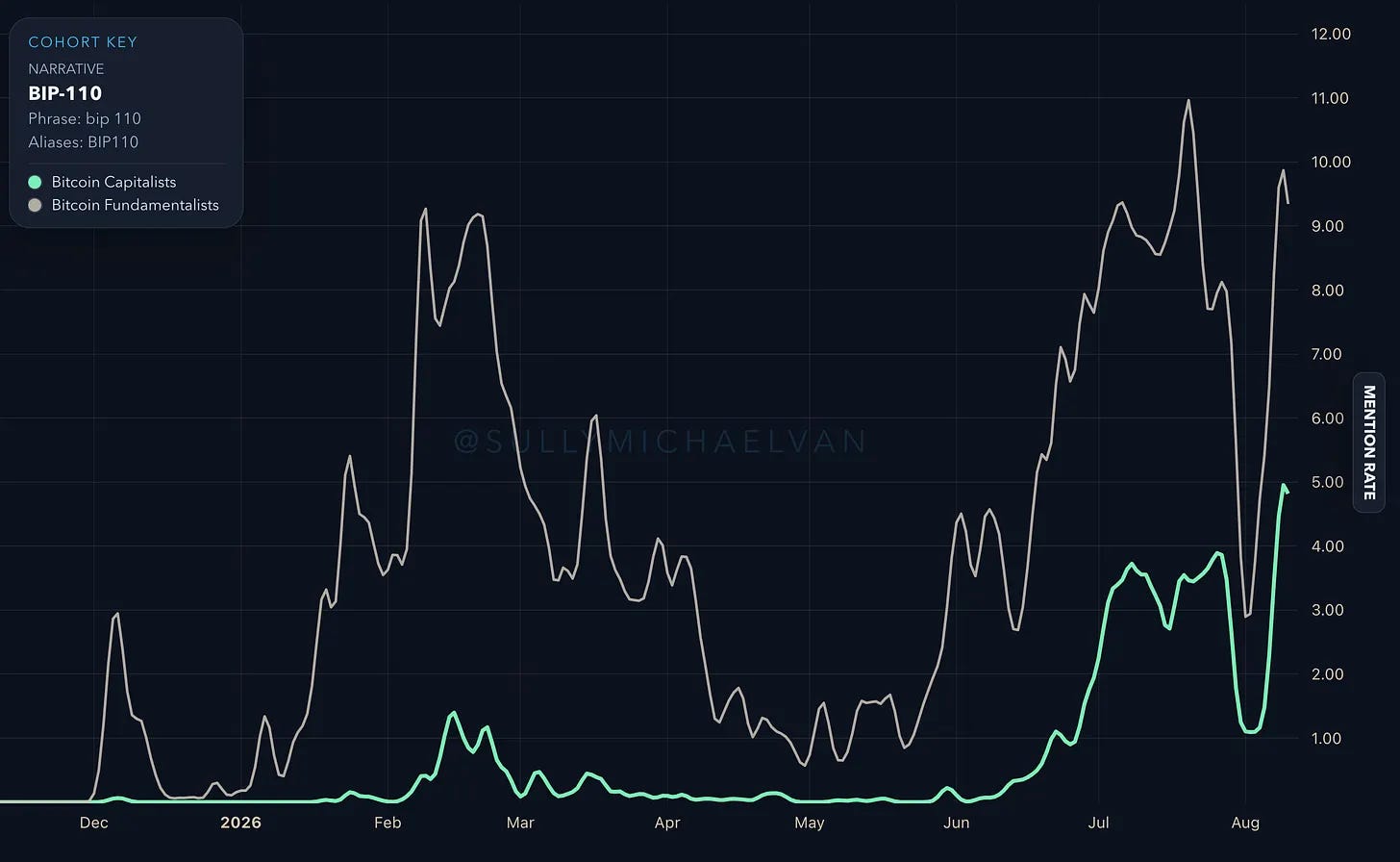
This chart lets you compare the mention rate of BIP-110 across these two groups.
While it was a highly relevant narrative, it was much more prominent among general Bitcoiners compared to the MSTR shareholder cohort. This effect is even more pronounced if you look at some of my other more specific sub-cohorts (like Bitcoin Fundamentalists).
You can see the debate evolve as the line progresses.
The BIP-110 narrative was much more popular in the broader Bitcoin space, and only entered the MSTR conversation as the fork deadline approached and Saylor became more involved.
“But Sully, what is that strange dip about right toward the end? Is your data faulty?”
Nope.
It’s just that another narrative came out of nowhere and took the majority of mindshare.
Coldcard.
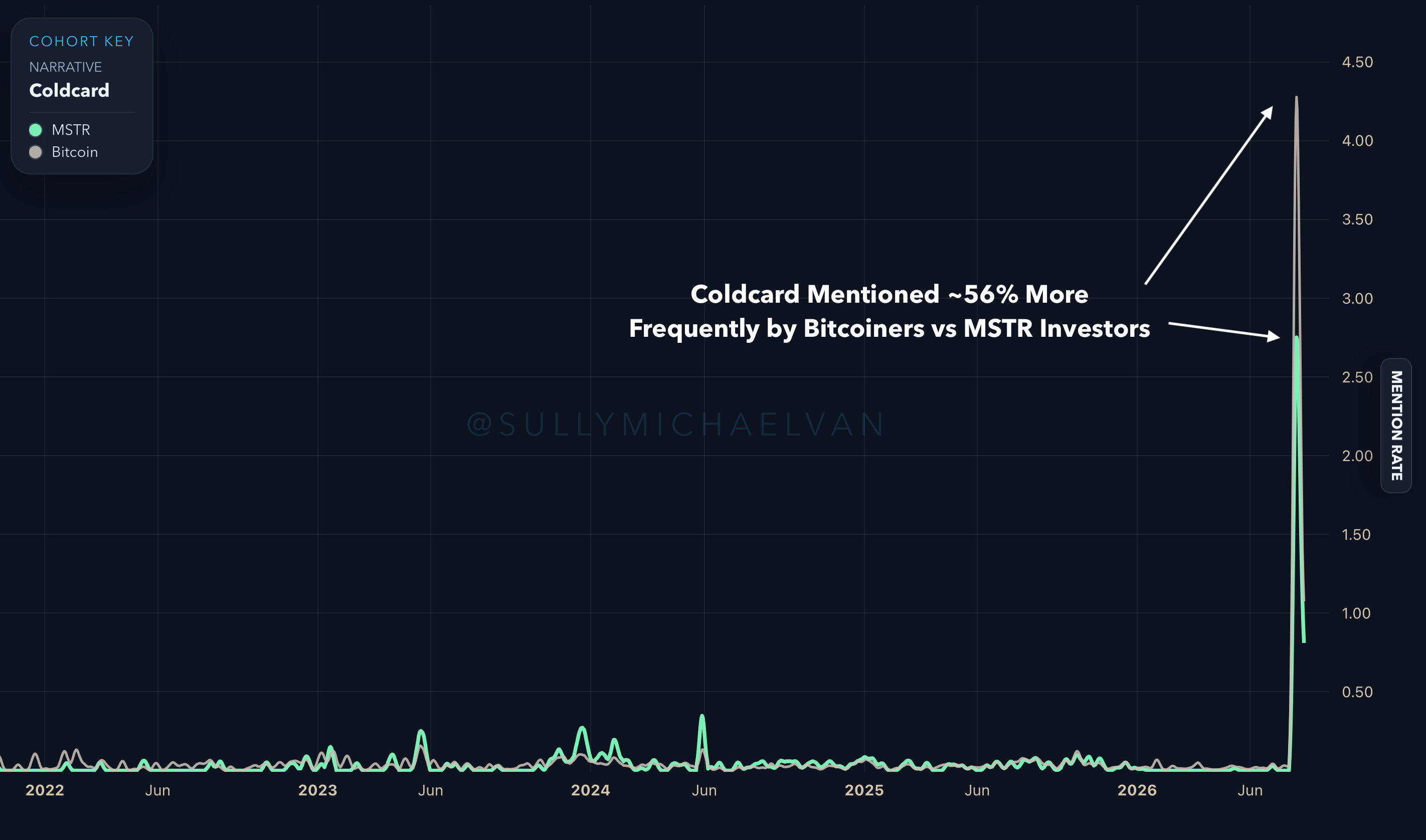
If you’re looking for a much more detailed deep dive into the aftermath of this event, I’ve written about it extensively in Coldcard Carnage. But for our purposes today, we’ll compare how broadly the two cohorts discussed it.
Despite Coldcard being an extraordinary ecosystem-wide event, its mention rate was ~56% higher among Bitcoiners broadly than among MSTR shareholders.
“How does this have anything to do with that crazy chart with all the lines at the beginning?”
Glad you asked.
Because it shows a couple of things:
The Bitcoin community has fractured. We are no longer one happy little community, but a massive ecosystem with different pockets and perspectives. This has never been more pronounced than in the age of algorithms, when we all see different versions of what matters.
Within those communities, people are responding very differently to recent events. These negative narratives occupied considerably less of the MSTR cohort’s attention than they did among Bitcoiners broadly.
And these are not the only differences.
MSTR investors have had to endure all of this Bitcoin FUD in addition to the MSTR FUD.
So you’d expect them to be more fearful, right?
Nope.
Greedy When Others Are Fearful
I know, I know.
Another crazy chart with lots of lines.
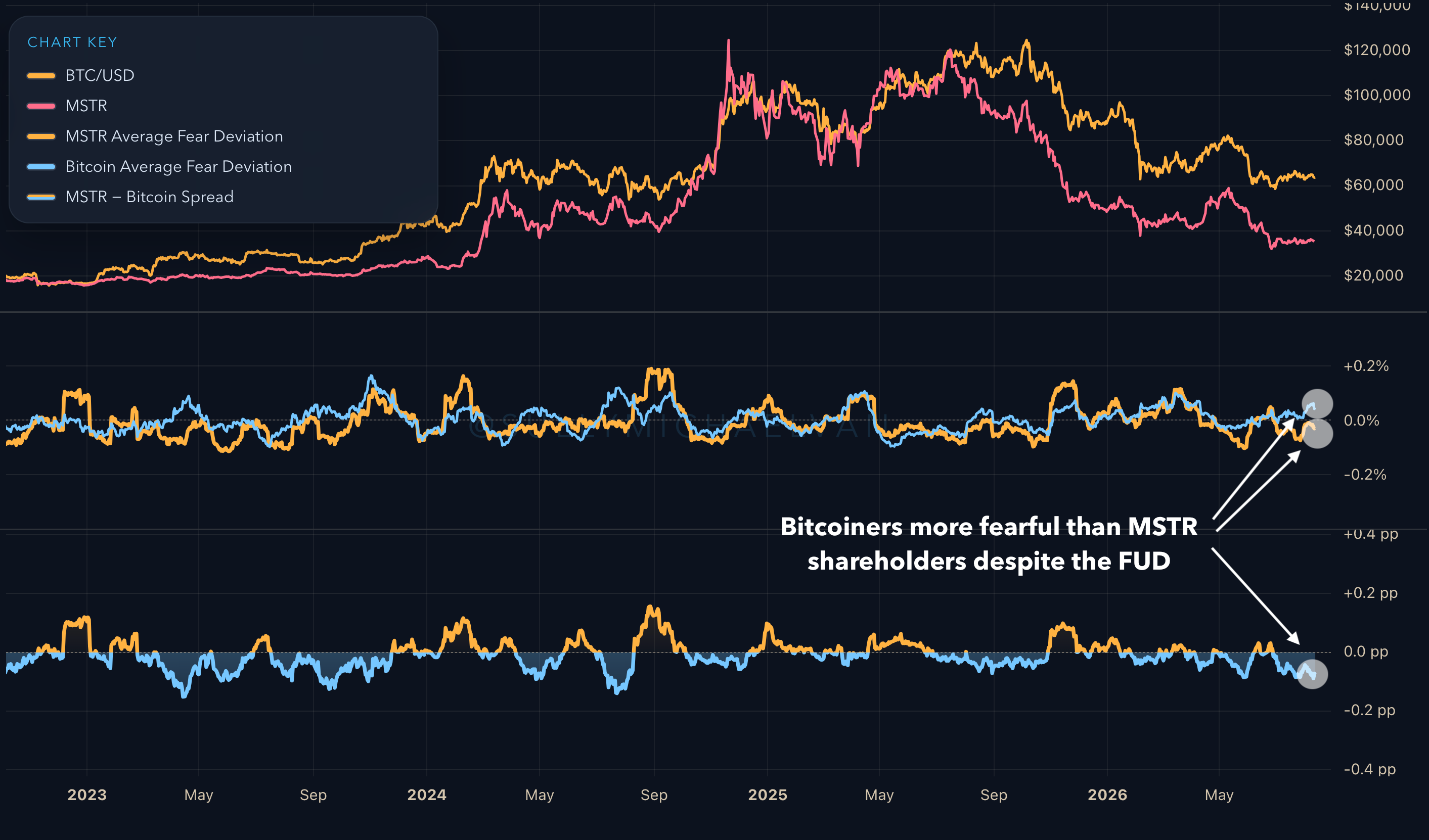
Fortunately, this chart uses the exact same format and cohorts as the first. The only difference is that we’re looking at “fear” instead of “conviction.”
Despite MSTR being down much more than Bitcoin from a price standpoint.
Despite the forced liquidation narratives.
Despite Saylor selling Bitcoin.
Despite the STRC doom loop.
MSTR investors are still more convicted and less fearful than the broader Bitcoin community.
This is all happening while Bitcoin price action has been incredibly constructive to the point where price is barely going down despite many negative news events. There are a huge number of macroeconomic variables out there that are well beyond my ability to predict, but the one thing I do have a pretty good pulse on is Bitcoin’s social layer.
Regarding that social layer, I have a much clearer interpretation.
The tourists are gone.
Although I still cannot say that we’ve bottomed with a high degree of certainty, I can tell you that I’m currently the most bullish I’ve been in quite some time.
All this research doesn’t tell us where MSTR will trade tomorrow.
But it illustrates something interesting.
Strategy has built an investor community whose emotional state has recently become more independent from Bitcoin. Its shareholders are remaining remarkably resilient through both controversy and FUD.
Many people simply perceive MSTR as a Bitcoin derivative.
This is true in regards to sentiment data too… usually.
But not right now, there are starting to be some distinctive differences.
Low volatility and boredom would normally be expected to drain attention and confidence from a higher-beta risk asset like MSTR.
We’re currently seeing the opposite.
From a sentiment perspective, this relationship is becoming more complex.
When I talk about MSTR’s hidden momentum, I’m not describing some super-fancy derived volatility metric or a pattern in its price, but rather a mood shift happening behind the scenes. One that, in my opinion, is quite bullish.
Oh, and in totally unrelated news, I bought some MSTR this morning.
I like that you take off all the emotional clothes and standing there in its birthday suit is the data. The sexy data all naked and alluring baring its soul willing to tell you whatever you want to know.
LMAO the closer. Love it man.
As usual, I feel like I can "sense" what you're saying from spending (too much) time on X. It aligns with my gut. It registers as "true."
In my experience that Strategy investors are pretty unflappable. I think as a group they have the lowest time preference and deepest understanding of Bitcoin's economics/pricing dynamics of any Bitcoiner subset. They also take a disproportionate amount of shit, IMO. Especially from the fundies.