
Breaking Down (BIP-110)
What the language data tells us about Bitcoin’s most divisive debate.

I didn’t want to write this.
One of the deepest lessons I’ve learned from researching sentiment data is how irrational and angry people get towards the bottom of bear markets. People that are historically aligned often fall into conflicts that wouldn’t exist near tops.
The BIP-110 debate increasingly feels like one of those moments.
I wanted no part of that.
I’ve been publicly cancelled before, and I have no desire to go through that again. I know how painful it is to have an angry crowd criticizing and shaming you, which gives me a strong bias to avoid situations exactly like this one.
But I’m pushing against that bias because (for better or worse) I have a novel dataset that offers a unique lens on the BIP-110 debate.
I’m going to attempt to keep this unbiased, but before I do, I’m going to lead with what will be my highest-conviction opinion of the entire piece:
People like Mechanic and Luke Dashjr understand Bitcoin’s consensus mechanisms better than I do, while Adam Back and Jameson Lopp grasp Bitcoin’s technical nuances more deeply than I ever will.
I am not here to pretend I understand these dynamics of this debate better than the people who have spent years studying them. That’s not why I’m writing this.
“Then why should I care what you have to say?”
Because there is another side of the debate that is also important, and it’s on this side I have a different perspective.
The social layer.
For those of you new to my work, I’ve been researching the language, narratives, and emotional patterns of different groups throughout Bitcoin. I’ve been (obsessively) studying the emotional regimes and crowd psychology associated with the space.
That includes the people now publicly associated with both sides of the BIP-110 debate… and the differences between these groups are striking.
I believe I would be doing a disservice by keeping that data to myself simply because publishing it might piss people off. So there will be no paywall on this piece, no call to action halfway through, and I won’t ask you to become a subscriber.
I simply want these charts to exist publicly, where anyone can examine them or interpret them differently than I do.
I will try to present it as fairly as I can, but I am not neutral, and neither is anyone reading this.
People will inevitably see different things in these charts.
This data cannot tell us who is technically correct.
But it can help us to surface clues about how the debate is evolving, who thinks they are winning, and why I believe one of these groups is currently experiencing an engagement-reinforced narrative environment.
Let’s begin.
Contrasting Conviction
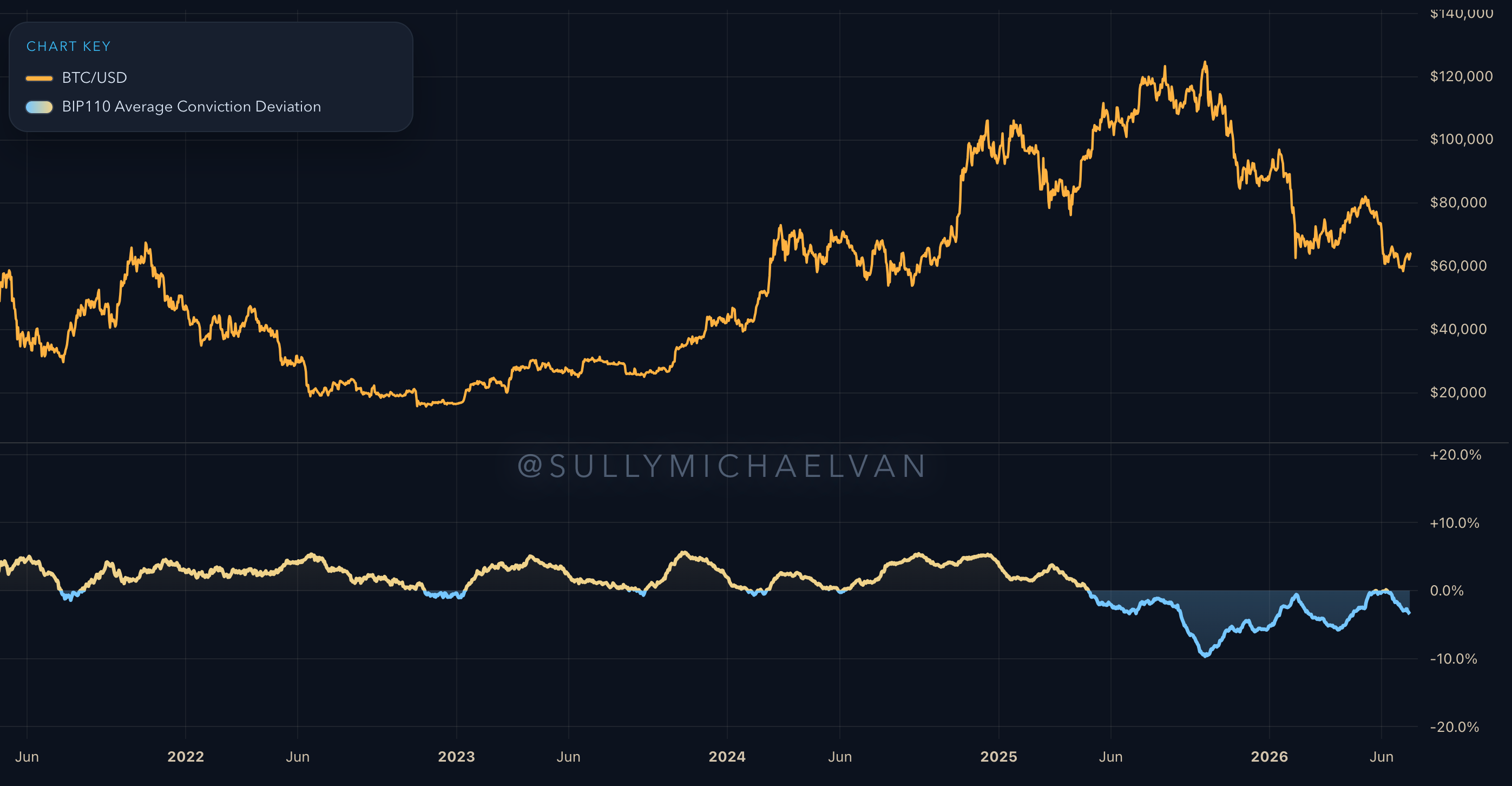
We’re going to start with what I personally find to be one of the most interesting emotions to analyze.
Conviction.
This measures the amount of confidence in someone's language over time (gold line). The inverse of this is hedging (blue line), which shows up when people are less confident or put more qualifiers around how they speak.
In the chart above, you can visualize the language data for the most active BIP-110 supporters. The conviction/mood data I’m going to be showing today goes back much farther than when Core v30 was released, which is especially interesting because it allows us to visualize the shift in their language before and after its release.
Here’s this group’s conviction over the last four years.
You’ll note that their confidence has fallen sharply.
Put another way, they’ve been using “hedging” or “uncertain” language much more often over the last year.
Interestingly, the lowest levels of conviction for the Pro-BIP-110 cohort begin around the release of Core v30 in October 2025. This is going to be a recurring pattern across the piece, as this ends up being a common inflection point across a great deal of the emotions we’ll cover today.
When I first shared this on X, many people in the Anti-BIP-110 camp assumed this meant that “BIP-110 folks are not confident they will succeed”.
That may be part of the truth, but I think I can be slightly more precise.
Conviction is related to the stories we tell ourselves.
Humans use stories as a way to make sense of the world. When stories crumble, so too does our conviction. When reality separates from your worldview, you become less confident.
Here are seven brief examples of conflicting stories surrounding Bitcoin:
Bitcoin is digital gold. / Bitcoin is peer-to-peer cash.
Bitcoin is for saving. / Bitcoin is for spending.
Nodes decide. / Markets decide.
Bitcoin is property. / Bitcoin is money.
Bitcoin is neutral. / Bitcoin is inherently political.
Users control Bitcoin. / Economic power controls Bitcoin.
Institutions legitimize Bitcoin. / Institutions neutralize Bitcoin.
I know individuals who believe every one of these stories. Many Bitcoiners hold conflicting ideas about what Bitcoin is in their heads at the same time.
But at the end of the day, each of these stories is just human-derived language used to conceptualize this often-confounding technology.
For example, I quite like “Bitcoin is digital gold” but what happens when Bitcoin surpasses the market cap of gold? Will you still anchor your view of Bitcoin to gold?
It’s with this idea of conviction being related to stories that I want you to hold in your mind while we move forward.
“But their conviction levels could have fallen for many reasons. It’s not necessarily because of BIP-110. Couldn’t it have been because of the price drawdown?”
To answer that, let’s bring in our next chart.
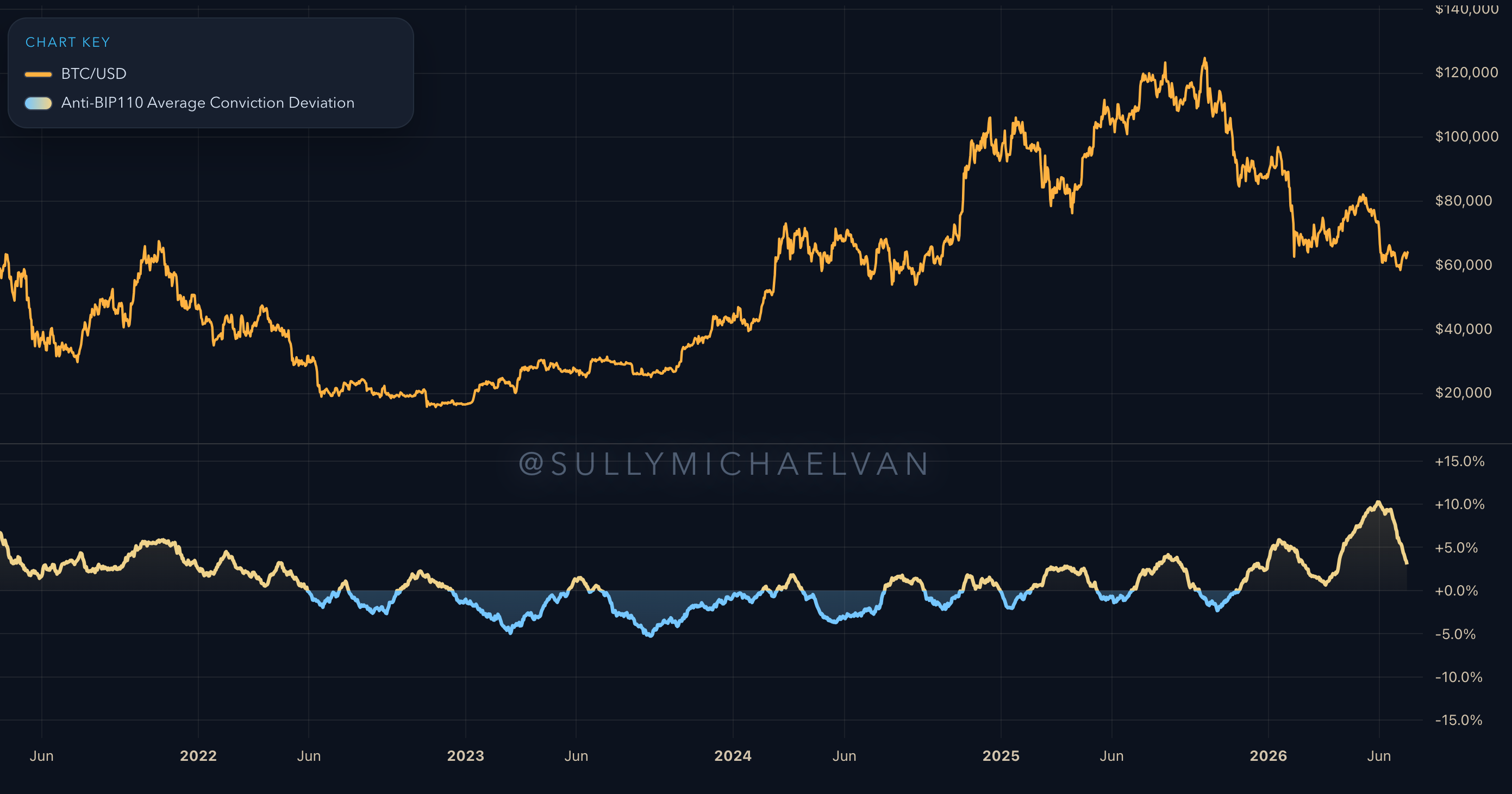
This one looks at the opposite group.
These are people commonly associated with being against BIP-110.
Same conviction level chart, same time range, same measurement methodology.
There are a handful of conviction deviations between these two charts, but there is something I’d like to draw your attention to.
Since this inflection point in ~October 2025, both groups experienced conviction volatility. You can even see the exact same dip at the end of October across both groups.
“But these groups hate each other, why would they move so similarly?”
Because despite the current infighting, we all still believe in mostly the same things. We all want to see Bitcoin win, the disagreements are just in the nuances of how we think that will happen.
The shared dips illustrate that both groups still respond to some of the same external forces, including price and broader events across Bitcoin.
Despite the similar movement patterns, there is a stark divide.
I personally believe this divide is caused by the Pro-BIP-110 group using increasingly high amounts of “hedging” in their language over this time period. I believe some of their frameworks and stories for conceptualizing what Bitcoin is are in crisis.
This may seem like a bit of a reach based purely on a singular group’s sentiment data, but as you’ll soon see, this is only one piece of the broader puzzle.
I’ve got a lot more charts.
Talking Past Each Other
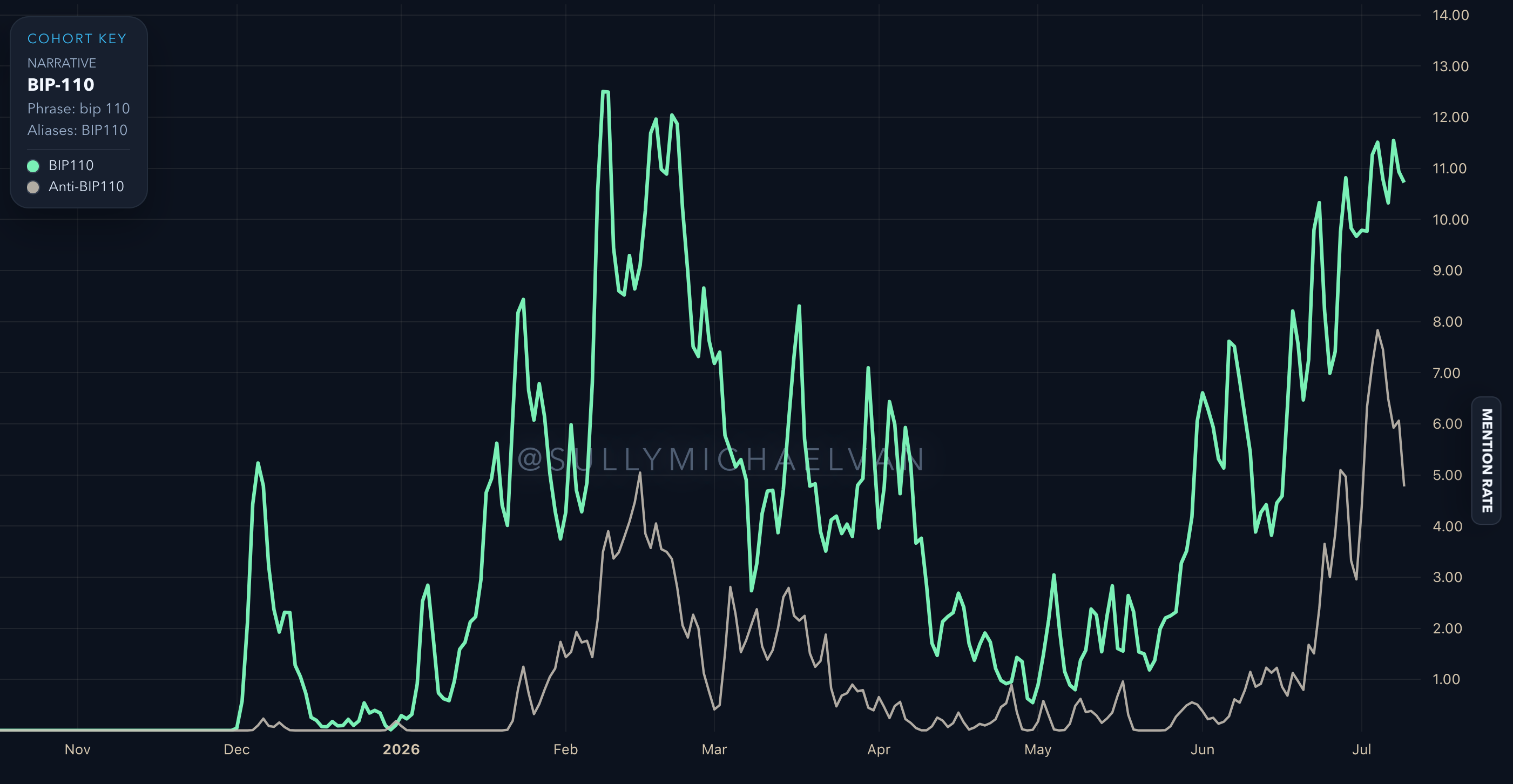
We’ll get back to analyzing the emotions of each group (wrapping up with my single most fascinating discovery), but first let’s look at what each group talks about.
The above chart is the mention rate for the phrase “BIP-110” across the Pro-BIP-110 and Anti-BIP-110 cohorts.
“No shit dude, of course the Pro-BIP-110 cohort talks about it more.”
True.
But I wanted to start with this just to visually represent something that lives at the core of this psychological divide.
Algorithms.
I’ve written extensively about this identity divide dynamic in The Fracturing Ideologies of Bitcoin, but I want to emphasize a point that I believe will help to understand how we got here in the first place.
Social media has long left its “timeline era” and serves a unique set of posts to each user. Every single one of you reading this piece sees a different side of the Bitcoin community than I do, and with that, we can often be blind to some of the things that are central narratives for other groups.
For folks who are Pro-BIP-110, they see content they are more likely to engage with. This is fantastic in some ways, because it means we get to see the things we want to see. However, it also creates dynamics where we can be more blind to the broader perspective.
So, of course BIP-110 proponents talk about BIP-110 the most.
But do you know who talks about BIP-110 the second most?
The Anti-BIP-110 group.
Again, not surprising.
But what this illustrates is that, to the Anti-BIP-110 cohort, this whole thing is not the main focus. They have a much wider range of topics that they focus on. This gets even more pronounced if you look at people in the Bitcoin Treasury space who simply do not care about this discussion in the slightest.
But instead of showing you this same chart with only one group switched out, let me demonstrate this from a different angle. We’ll look at how much the broader Bitcoin ecosystem talks about MSTR compared to the BIP-110 cohort.
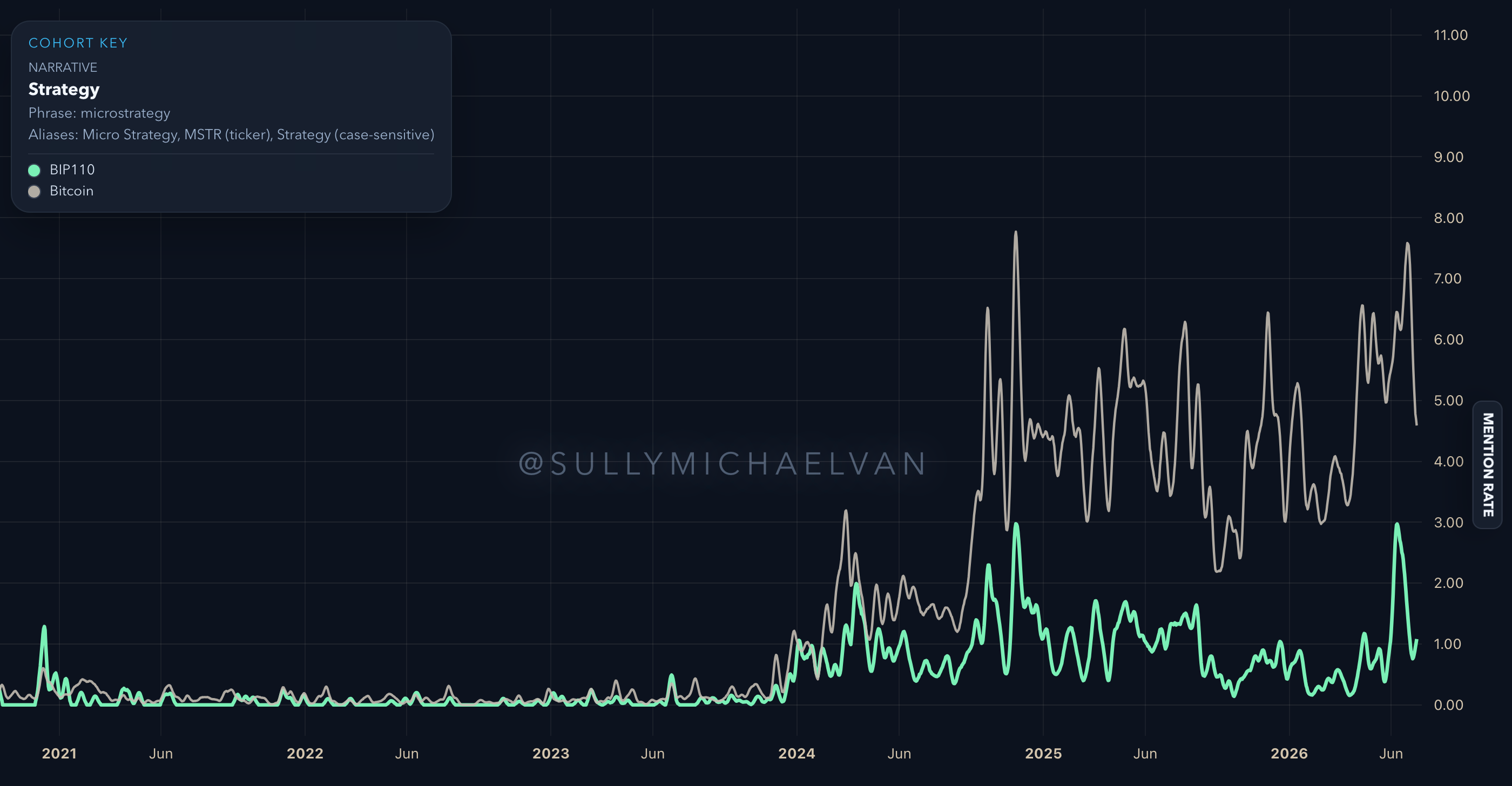
Similar dynamic.
While people deep into the Strategy space are not talking much about BIP-110, people in the BIP-110 sphere aren’t talking as much about MSTR.
Now both groups almost certainly are hearing about the other one, but because of our little algorithmic worlds we all live in it can often be challenging to have a holistic view of where the entire space currently sits.
I’ve talked to people who have been in the space for a while that were blown away by just how popular this section of the Bitcoin community has become. When you interact with this community through the lens of your own algorithm, it’s likely you may not have the most holistic view.
You could be blind to it.
With that in mind, let’s paint a more precise picture.
Here are a couple of stats about how much each group talks about BIP-110:
Over the last month, the phrase “BIP-110” appeared in ~8.5% of posts from the Pro-BIP-110 cohort, it appeared ~3.8% for the Anti-BIP-110 cohort, and ~0.2% for those not active in the debate.
Said another way, BIP-110 occupies roughly 40 times more of Pro-BIP-110’s conversation than it does the broader Bitcoin ecosystem.
I think this is important to understand because the latter group is a proxy for the silent majority.
I even see myself in this data. I’ve rarely spoken about the topic (not because I haven’t wanted to) but because of how heated the debate grew. As I literally started this piece off with, I still think there is a reasonably high likelihood I’ll face personal attacks just by presenting the data.
It’s also important to note that there is a huge group of users who go completely silent during the boring times and disengage completely until price starts running up again (or something interesting happens).
These people are almost completely out of the loop right now.
Which brings me to a critical point.
What happens when they come back and ask what’s going on with the BIP-110 debate?
How do they get up to speed? How do they decide?
These people are generally not as technical or as plugged into the day-to-day of this debate. This is why technical perspectives are not enough. There is a social element here too.
They are likely to look to some of the influencers in the space to help them form their opinion during this divisive time… which brings us to another interesting discovery.
The people driving the debate also introduce some unique dynamics:
The average Pro-BIP-110 account has ~40k followers.
The average Anti-BIP-110 account has over ~170k followers.
This means that the average Anti-BIP-110 account has an audience of roughly 4.5x the average Pro-BIP-110 account.
Four caveats here, before getting to the most interesting point in this narrative section:
These are curated samples of public accounts most closely associated with each side of the debate. Many people don’t publicly share which way they lean, and I obviously have no way to capture that information.
These numbers are rapidly shifting as new people enter the debate. They will likely not be the same even a day or two from now. This should only be viewed as a snapshot.
I’m not (yet) formally including accounts like Michael Saylor as “Anti-BIP-110” as he’s been silent on the topic until very recently. However, if the attacks get more aggressive, I think he (and the entirety of the Bitcoin treasury complex) is likely to grow more involved.
Followers are an imperfect measurement of influence (and they definitely do not equal unique audience reach), but I think this is representative of the broader trend.
This is irrelevant when it comes to technical arguments or economic sway, but in the process of social consensus these dynamics do matter quite a lot.
“These numbers just show us that BIP-110 is a grassroots movement, with the average guy supporting it.”
I totally agree.
It absolutely is.
I have a huge amount of respect for the people inside of the movement. They care incredibly deeply about Bitcoin and I find that to be admirable in the deepest way possible. Despite the fact I’ve already been criticized for sharing this data, I strongly believe the Pro-BIP-110 group is doing what they believe is best for Bitcoin.
With that said, I have reason to believe this group is heavily influenced by algorithmic dynamics.
I realize this can come off as an inflammatory thing to say, and I truly don’t wish any ill will. But I’m not going to hide these findings just because it may anger some people.
I compared each author’s BIP-110 posts to their non-BIP-110-related posts to see if I could tease out any engagement trends.
This is what I found.
For the median Pro-BIP-110 author, posts that included “BIP-110” received:
1.40x as many likes
1.66x as many replies
1.84x as many reposts
For the median Anti-BIP-110 author, posts that included “BIP-110” received:
0.78x as many likes
1.44x as many replies
0.69x as many reposts
Said more simply, Pro-BIP-110 authors get much more engagement across the board when they talk about BIP-110 compared to other topics.
Anti-BIP-110 authors get much less engagement through likes and reposts when talking about BIP-110, but they do get more replies… primarily driven by Pro-BIP-110 supporters debating with them.
For BIP-110 supporters, this can validate and reinforce continued discussion of this topic.
For BIP-110 detractors, this can subtly disincentivize talking about this topic.
A good representation of this dynamic (to give you something more concrete) is this recent thread between Lyn Alden and Mechanic.
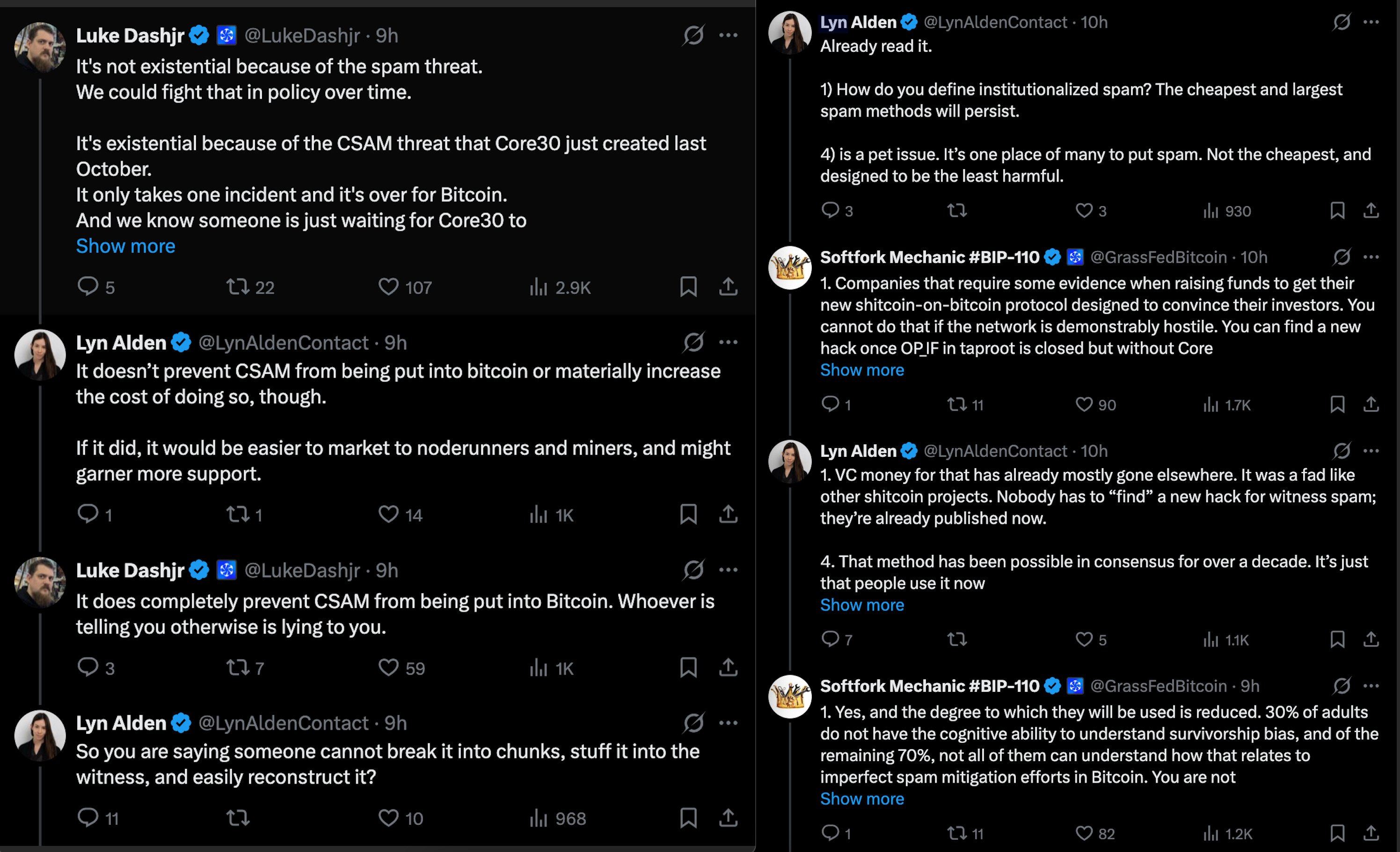
Lyn is quite infamous for her ratios, but her usual high engagement is completely absent here.
“Doesn’t that just mean that her audience realizes she is wrong?”
That’s one perspective.
But that’s absolutely not my view.
What I personally see, is that Lyn’s massive audience doesn’t care as much about this discussion.
This is only a singular thread, so we can’t give it too much weight, but it’s one of the starkest examples of the data above. Lyn is algorithmically disincentivized from engaging in these debates and is more likely to get criticism for sharing these viewpoints (not that it would ever stop her, she’s a legend) but she engages anyway.
“So it’s clear the BIP-110 guys are just in an echo chamber then right?”
I think it would be more precise to say that there is an engagement reinforcement loop. This happens to all of us. The algorithm is not optimizing for the most even view of the Bitcoin ecosystem, but rather showing us more of what we want to see.
I truly don’t want to be too critical of these folks, as I think we all experience this to some degree.
I personally fell victim to this dynamic around MSTR in late 2024. Every tweet I posted about MSTR blew up so I talked about it a disproportionate amount as the algorithm suddenly loved me. Getting wrapped up in narratives like this is one of the things that inspired me to pursue this sentiment analysis work so seriously and understand the human psychology element hidden behind it.
This is all to say that I am absolutely not above this and I think it’s important to treat each other with grace during this very divided time. After all, humans are emotional creatures (despite the layers of logic we place on top of the moods that often drive us).
With this in mind, let’s close out on the narrative analysis and get into the human emotions.
A Philosophical Fracturing
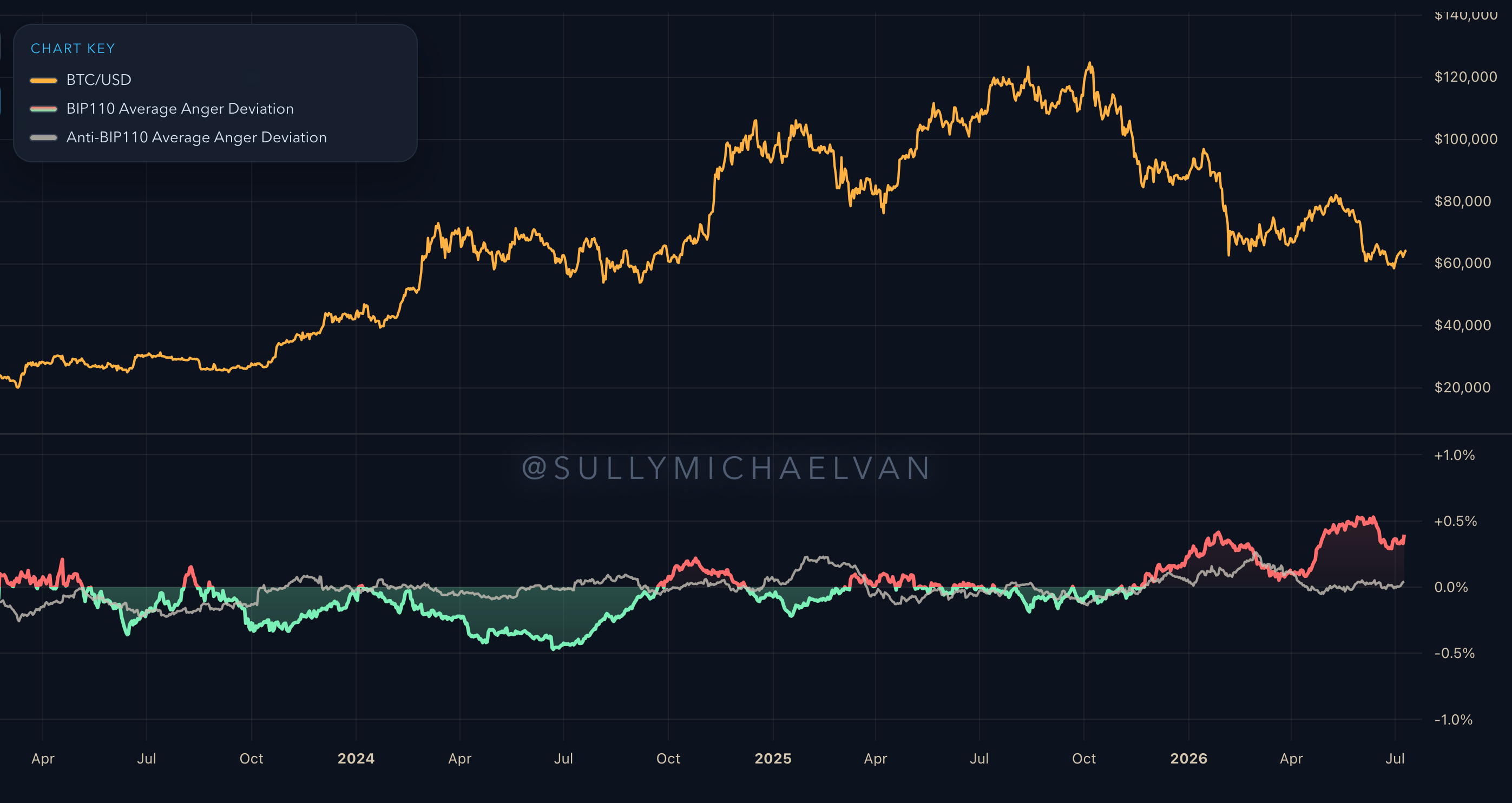
Each of these charts reflects a different mood.
The one we are looking at above is anger. This isn’t just tracking BIP-110-related language, but language each of these individuals used across the entirety of their conversations on X.
This methodology allows us to have a better lens into their shifts in mood over time, rather than simply measuring conversations around a singular divisive topic. The advantage here is that this gives us a wider view of how the people involved in this debate are changing over time.
And they certainly are changing.
Something fundamentally shifted with the Core v30 release in October of 2025.
You can see this initially by looking at the above chart showing the anger levels of Pro-BIP-110 vs Anti-BIP-110 folks. While the people against BIP-110 are relatively flat and unbothered, those who are proponents of BIP-110 have been in a persistently elevated anger regime.
This lets us visualize this emotional divide.
Both groups have their hyper-logical debate topics, and both groups would likely tell you that this debate isn’t emotionally driven.
This is not true.
This debate is extremely emotionally driven.
Often, people like to believe they think without being influenced by their own internal moods or emotions, but this is not the case (I say as someone who used to refuse to admit that he was emotionally driven).
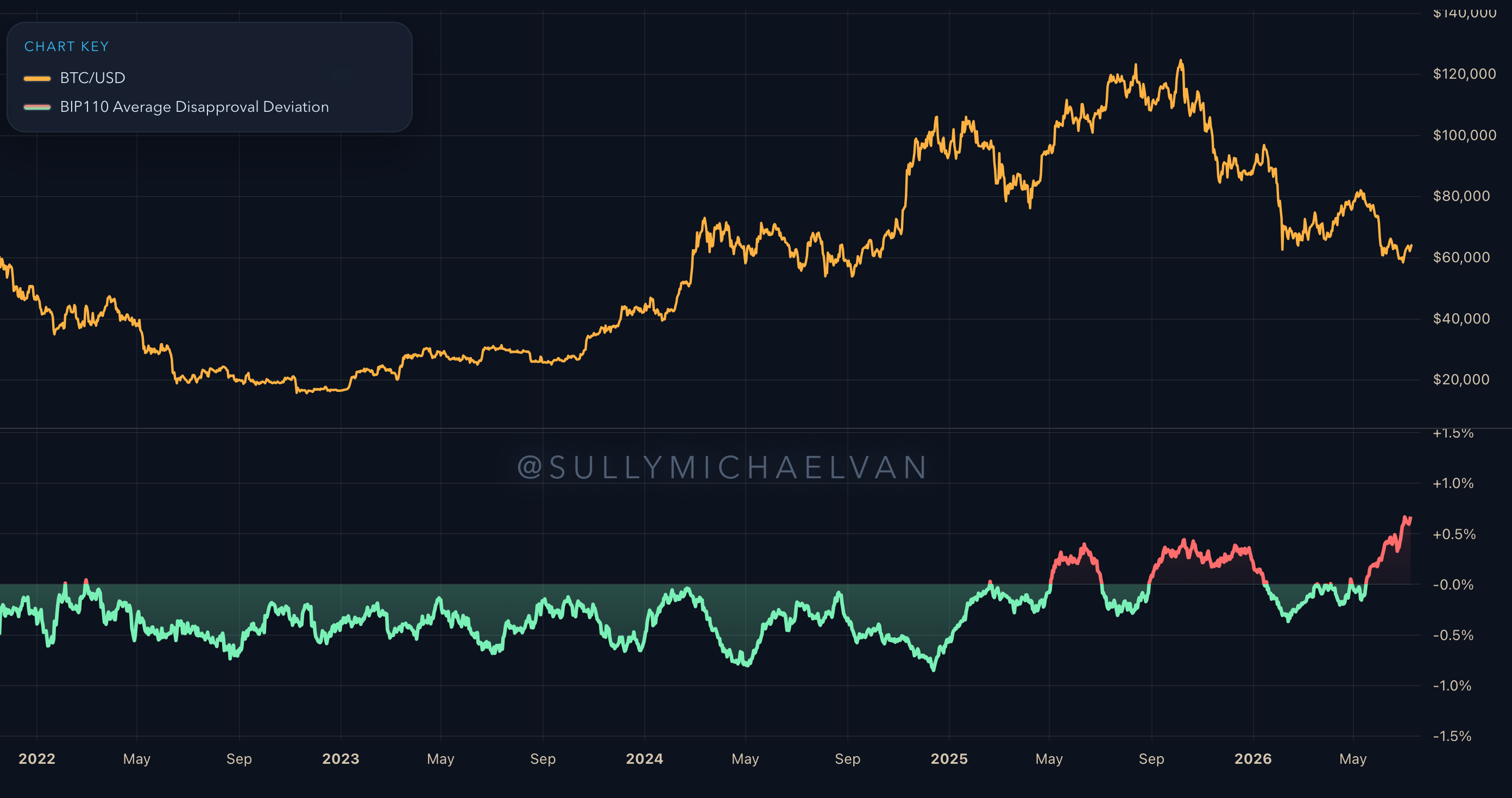
One of the starkest emotions for the BIP-110 group is disapproval.
“You already said they were angry, that’s basically the same thing right?”
It’s not actually the same thing.
Anger is fueled by rage, and when people are angry, they often look for villains to blame.
One of the more interesting findings from my research into this sentiment data is how different moods are related. Some emotions tend to proceed others.
A common form of this is that’s appeared during previous research:
People get angry.
Because they are angry, they look for villains to blame.
These people will often find a villain to blame.
They then speak disapprovingly of this villain.
This emotional dynamic shows up frequently in language data and it is represented above as you can see that the Pro-BIP-110 cohort is expressing extremely high levels of disapproval.
“Ok, this doesn’t tell us anything, of course BIP-110ers are mad that people are not adopting their view more broadly."
Fair.
That’s why I saved the two most interesting (and more nuanced) charts for last.
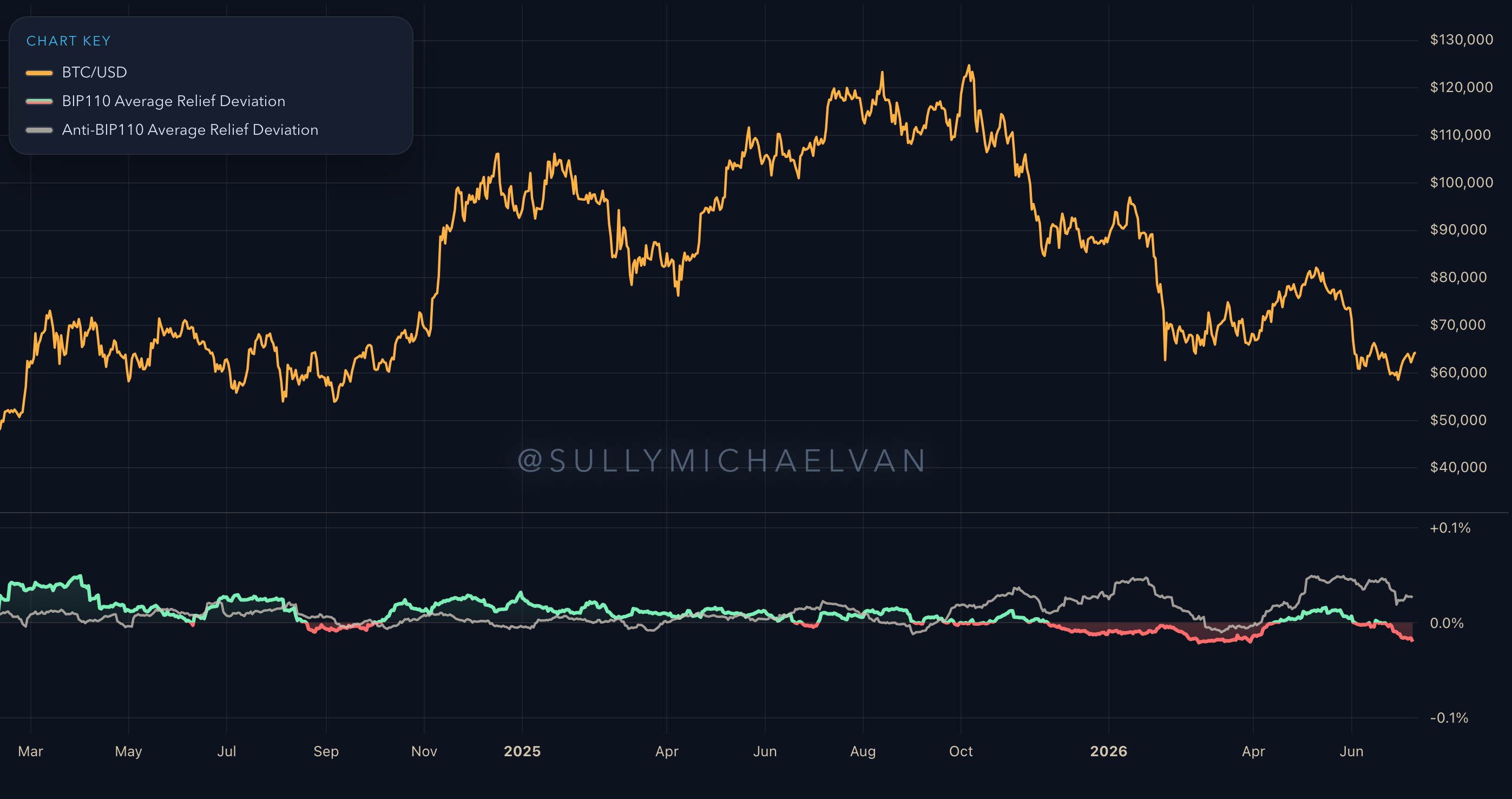
Relief is usually the emotion that comes after stress.
It’s the kind of emotion you’d expect to see more of after a battle is over.
And, like most of these charts, you can really see where the divide opens up around October of 2025.
When I first showed off the conviction charts publicly I had a handful of people on the Pro-BIP-110 side tell me that the high levels of conviction among the Anti-BIP-110 side were false bravado.
If that were the only mood I had data for it would be challenging to argue against that perspective, but looking at these things in a more holistic manner tells a much more complete story.
A void opened up between these two groups when Core v30 released.
The Anti-BIP-110 cohort grew increasingly relieved directly following the release of Core v30, but this relief gap tightened around March of 2026. Broader Bitcoin relief levels declined around this time (likely impacted by price to some degree), but there were other facts that may play a role:
The BIP-110 argument intensified significantly.
The first BIP-110 signaling block was mined on March 1st.
Phrases like “hostile fork” and “attack” started to be used more heavily.
After this short period of tightening, however, the gap widened once more and has generally continued to grow.
I believe this is important as relief may demonstrate that one group sees the fight as being already over (relieved) and the other appears to feel like the fight is only just beginning.
Only one can be right, and we’re going to find out very soon.
Should be exciting, right?
Well… apparently not.
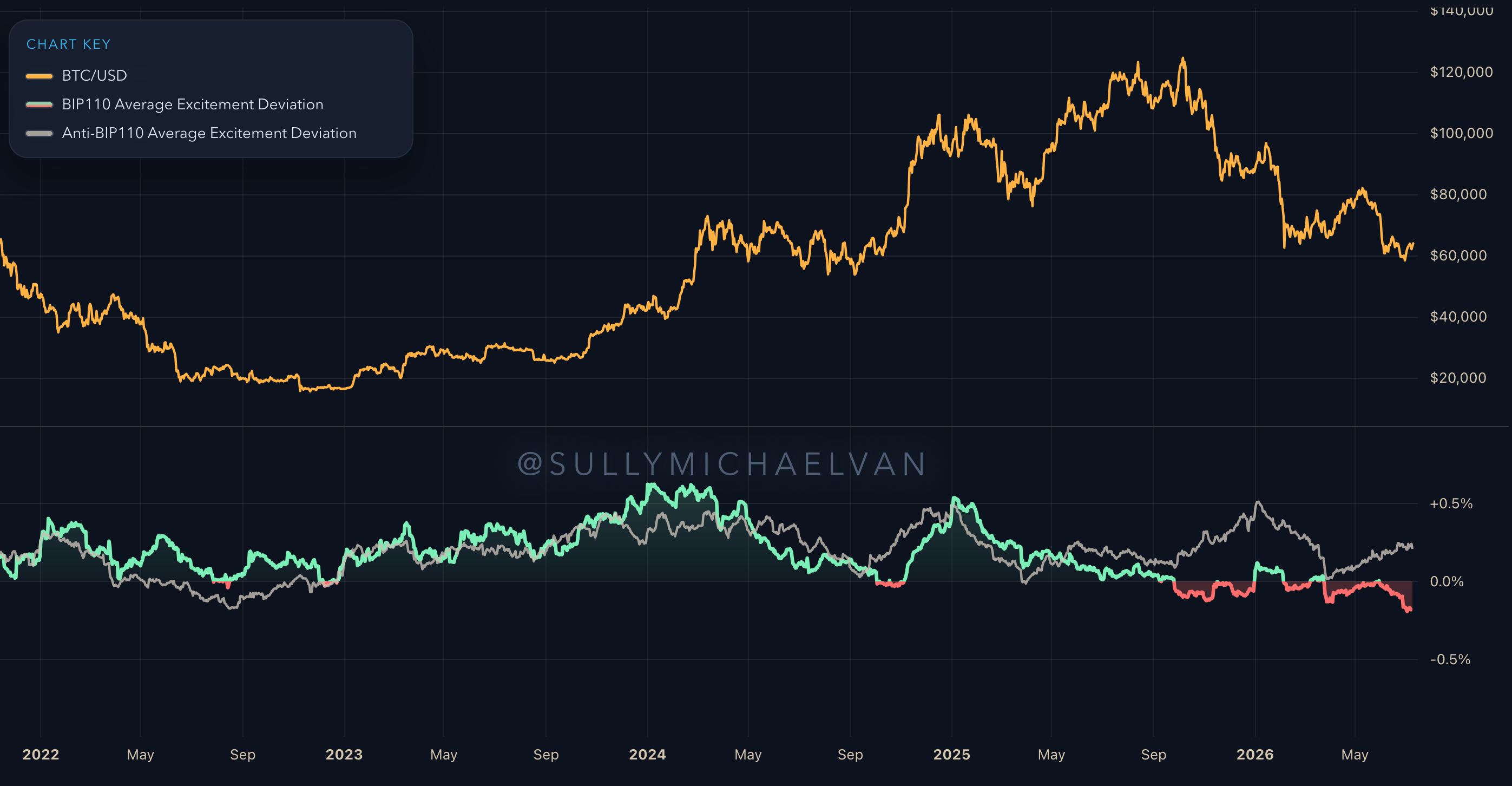
Excitement may seem obvious and straightforward, but human emotions are almost never as straightforward as they first appear. And we’re going to dwell on this one slightly as it is the most important finding of the entire piece.
The mood of excitement has a strong relationship with time.
“The fuck are you smoking bro?”
I know, I know, but stay with me for like one paragraph, it’ll be worth it.
Whereas optimism is more forward-looking and reflects how you think about the long-term future, excitement is anchored in the here and now. A vacation happening six months from now is slightly exciting, a vacation happening tomorrow is extremely exciting.
With this in mind, I’d expected to see the excitement levels for the Pro-BIP-110 cohort increase as we get closer to flag day (when enforcing nodes begin rejecting non-signaling blocks).
But to my surprise, that isn’t the case at all.
Their language data actually suggests that they are getting more energetically depleted (bored) as we get closer, where the Anti-BIP-110 group is the one getting more excited.
This was the most surprising finding for me and the one that most conflicted with what I personally expected to see in the data, which is why I’ve felt so compelled to share it.
Just to be clear here, this is not saying that BIP-110 proponents expect defeat.
These are subtle shifts across the entire group’s language.
You’ve likely experienced this in your life if you’ve seen a friend start to speak slightly differently when they are excited about a new budding relationship. Or if someone in your family slowly becomes more nihilistic about the world, they’ll use more negative words to describe things.
Their language changes.
Often subconsciously.
Right now the Pro-BIP-110 group’s language is growing less excited, despite the fact that flag day is moving closer and closer.
Closing Thoughts
This language and sentiment data can occasionally get a bit too abstract, so to wrap up, I’m going to anchor it in something more personal and human.
Imagine two people debating on stage.
One person’s arguments are not being received as well by the crowd, so they begin growing angrier and more emotional in their communication style. The other appears increasingly relieved and excited.
If you were sitting in the audience, how would you feel?
Would you find one side more persuasive than the other?
You don’t have to answer that, but if you sit in this mental state I think it might help to better understand where the silent majority of Bitcoin sits right now.
I’m not saying or sharing this because I bear the BIP-110 folks any ill will, but I personally was too swept up in the present narrative when I was early to Bitcoin and it caused me to make some poor decisions.
If this article helps a single person to navigate this tumultuous time a bit more clearly, I would consider it a resounding success (even if that means I risk getting publicly shamed again).
To wrap things up, I want to leave the data behind us and focus more on the human side.
I shared a lot of mood charts detailing the division in the two groups, but didn’t spend as much time talking about just how similar the two groups used to be. Across all of these charts, these individuals once moved in a more emotionally unified fashion.
They used to agree on most things.
I think this makes the current fracturing more heartbreaking.
We still agree on so much.
If you strongly disagree with this, I don’t blame you at all.
If there is anyone that has the capacity to understand how painful it must feel to think that your vision for Bitcoin is coming to an end… it’s other Bitcoiners. If I believed I was defending Bitcoin from inside a culture that no longer agreed with me, that would feel awful.
For that, I’m incredibly sorry.
I cannot speak for everyone, but I can assure you that even after all the infighting I still consider us to be on the same team, and I wish the best for all of you.
Resources for the Haters
This is unusual work and I’m open if people want to critique my methodologies and choices. I’d love to learn and make things better. Unfortunately, with the extremely emotional nature of this debate I’m expecting that many people will wish to jump on and criticize the person behind this post.
If that’s why you’re still here, I decided to make your life a bit easier:
Here is a link to why I got cancelled the first time if you’d like to try to dig it up and use it as ammunition for why people should ignore me:
Here are a couple resources where I’ve talked in detail about exactly how I’m doing this work if you’d like to publicly proclaim why sentiment data is bullshit:
Here is one of the stupidest price predictions I’ve ever made on X, if you’d like to critique my credibility in that manner:
Here is a link to my worst book review if you’d like to pile on, rank it as helpful, or add more fake/negative reviews if that’s your speed:
Hope this helps, thanks for your scarce time and attention! ✌️
This is a very high quality piece.
I personally been running knots (primarily virtue signaling considering I didn’t do full due diligence) the last few months and just have been an observer of all of the back n forth on X from when it began. Listened in on numerous spaces, read countless heated threads and back n forth between different influencers. However, I just recently really dove into the technical details to properly educate myself and understand both sides. I watched the Chris Guida and Super Testnet debate hosted by foresthodl and that was really eye opening for me as well as Lopp’s analysis on BIP110 and separately the history of Luke. Stephen Livera also released a very very good GitHub link that extensively explains the history of spam, core, inscriptions, op return, filtering etc. Now I’m reading this and it definitely confirms my growing belief that the knots/bip 110 leaders and main proponents definitely were and are WELL intentioned but DEFINITELY moved too fast resulting in many technical errors and general governance and consensus inadequacies. And tbh noticing the increase in a lot more offensive language and insults used by many bip110 proponents was very telling.
All in all great piece nonetheless
It’s easy to “see myself” in this data (as you always put it) and also to imagine the dynamics of the unfolding debate. Illuminating work, as always. Thanks for what you’re doing.
We’re hardly in the last chapter of Bitcoin and I could see this sentiment work becoming something like what on-chain analysis is now. But, with applicability outside our little bubble, too.
Also your last section is hilarious. I’m reminded of one of Eminem’s freestyles in 8 Mile where he steals all the other guy’s content before he can rap it.