
The Conversation Is Over
Bitcoin’s biggest debates are still raging, but the emotional lines have already been drawn.

I sat down to write this report thinking I was going to look at which sentiment signals moved the most this week, but as I looked at the data I knew there was a bigger story I needed to share with all of you.
To tell that story properly, I would have to zoom way out.
Bitcoin traded down to $58k, MSTR finally broke (way) below $100, and STRC traded as low as $72. This week was wild, don’t get me wrong, but there’s a bigger sentiment story hiding in the background.
With that in mind, let’s skip the preamble and dive right into the charts.
Market Mood
Disapproval Deepens
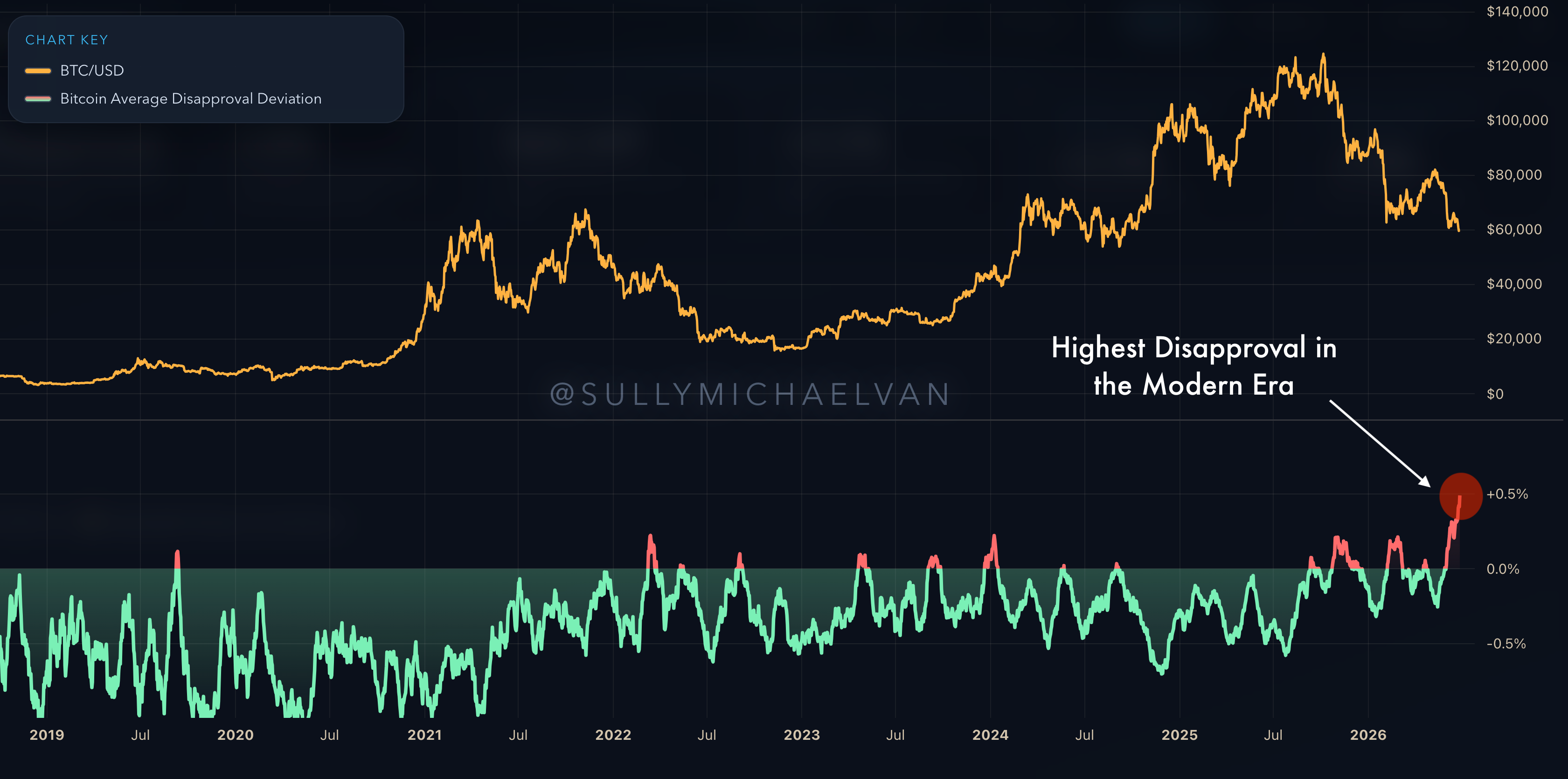
The weekly move on disapproval was interesting on its own, but zooming out to a much wider view makes the change even more stark.
What’s surprising here is that we were already at high levels of disapproval across the Bitcoin community, we’re now sitting at the highest levels of disapproval in the modern era.
The short-term emotional shifts matter, but it’s the broader context that gives us the most fascinating lens to look at the market. Watching disapproval reach levels this high, I knew it would be worth dwelling on a bit more intentionally.
“People are mad and price is down, who cares?”
Disapproval doesn’t just mean people are mad.
It’s not anger or worry, it’s much more judgmental. I think about it as the emotion of criticism.
Where anger is a “hot” emotion, disapproval is more “cold”.
Anger often precedes irrational thinking, where disapproval is relatively logical.
I’ll be putting out a deep research piece in the next few days about emotions that have the highest statistical correlations to the Bitcoin price. Disapproval is one of them, so seeing it so uncharacteristically high raised some alarm bells.
But why is it so high?
There are two topics currently causing a ton of division in the Bitcoin community:
Michael Saylor
BIP-110
I think about price like an amplifier. These arguments have been growing behind the scenes, but the negative price action fueled the flames.
Everything we’ve talked about so far made intuitive sense to me.
The timeline is BAD.
The next emotion helped me better contextualize exactly where things were at.
Curiosity Caving In
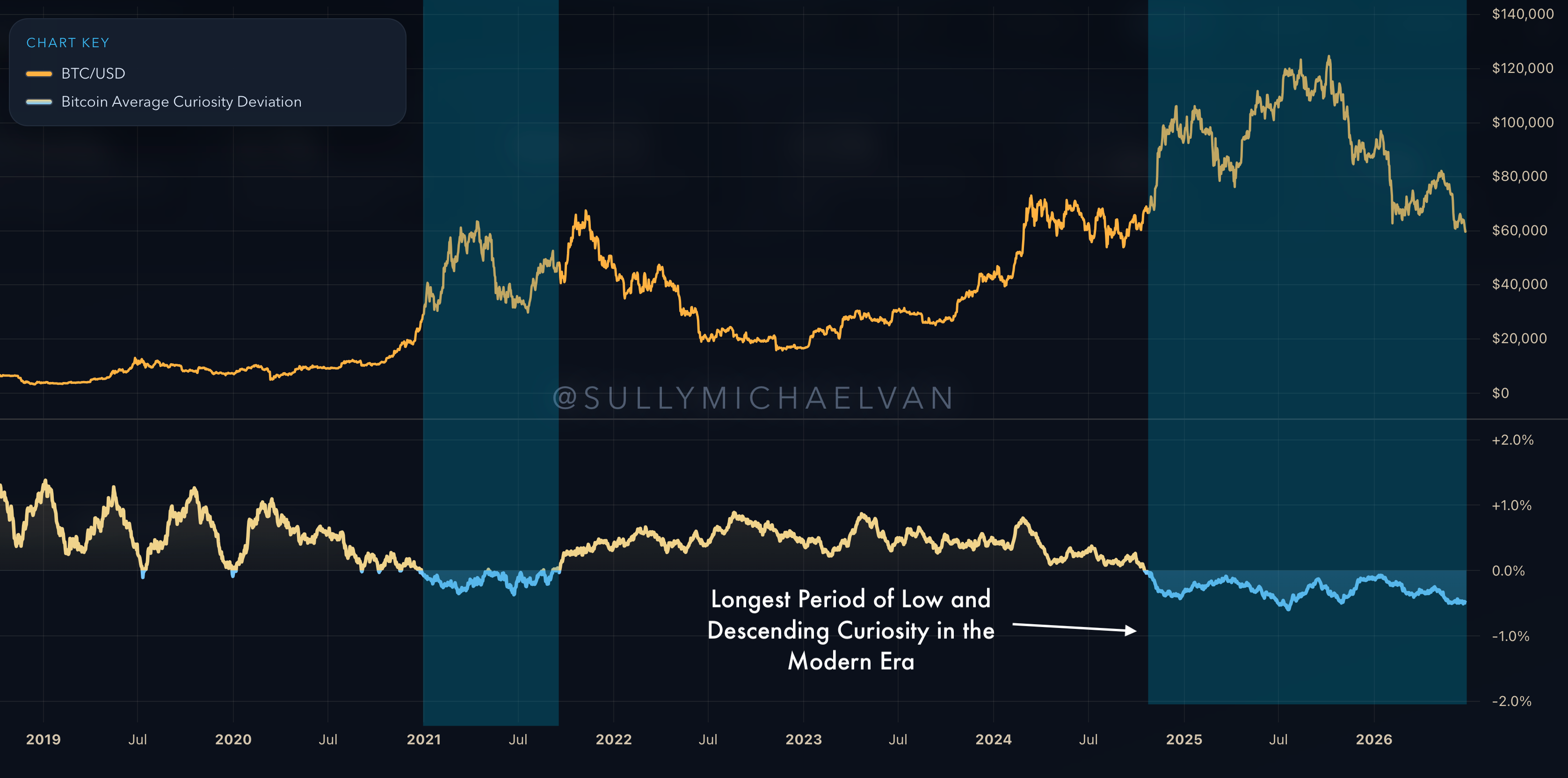
Disapproval wasn’t the only emotion that stands out right now when zooming out.
Curiosity has been negative for one of the longest stretches in Bitcoin’s history.
Looking through a wider lens is helpful here as it lets us contrast the current period to the 2021 bull market. At first, the 2025 price action looked incredibly similar from a sentiment perspective. Curiosity fell as the price ran up.
This makes sense if you think about it.
Curiosity is the emotion of questions.
It is the mood of open-mindedness.
Bull markets are not typically a time of people being open-minded, asking questions, and trying to learn and update their worldviews. Bull markets are historically a time of optimism, excitement, and heightened conviction.
This contrasts with bear markets which are typically a time of curiosity.
“So what the heck is happening now?”
That’s the whole story, and it’s the reason that I decided to take a broader lens this week and have you focus on how non-standard things currently are.
I’ve spent a great deal of time thinking about this, and I have an analogy that will bring this all together… but first, more charts!
Narrative News
Saylor is Selling?
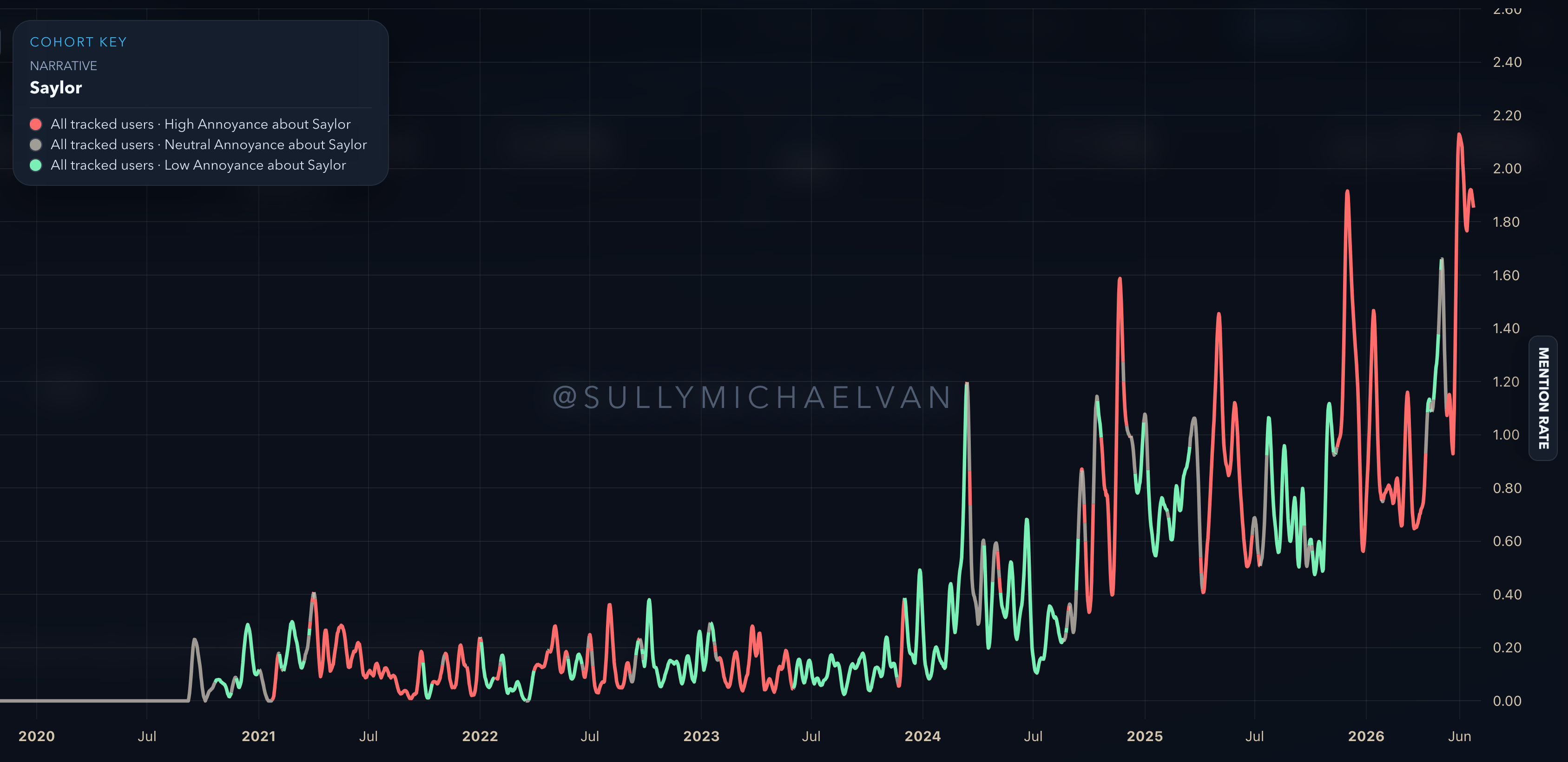
There’s a lot going on with this chart, but I hope you’ll bear with me as I’ve invented another new way to visualize Bitcoin sentiment.
What you are looking at here is the mention rate of the phrase “Saylor” over time since 2020. You can see him first start getting talked about across the Bitcoin community as MSTR began stacking sats.
You can see the rate his name was mentioned grow over time and since 2024 things really ramped up. This makes sense as his Bitcoin buying machine took on a life of its own during this time frame.
“I get that dude, but why does it look like a Christmas tree?”
This is the fun part.
I jammed two ideas together.
The color represents how much “annoyed” language people were using when speaking about Saylor.
Red = More annoyed than average.
Grey = Neutral.
Green = Less annoyed than average.
Not only is Saylor being talked about among Bitcoiners more than ever… Bitcoiners are significantly more annoyed about him.
Before I bring this thing home, let’s take a look at one more narrative difference.
Fork Wars 2.0?
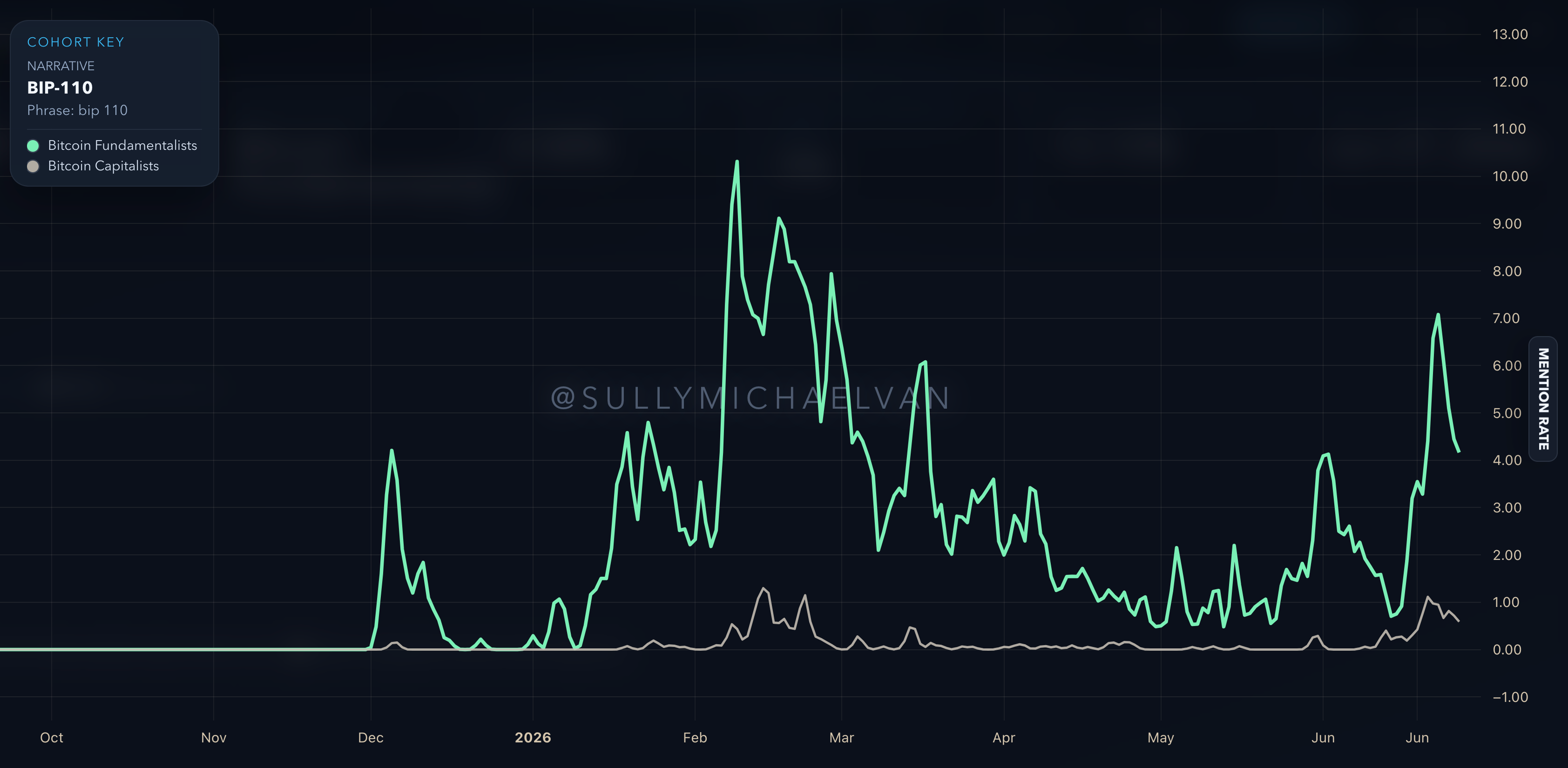
The debate around Saylor and STRC isn’t the only one happening right now. Mention rates of BIP-110 are increasing across the broader Bitcoin ecosystem right alongside this increase in disapproval.
But the interesting dynamic I wanted to draw our attention to here is how different the mention rate is across these two different groups.
I wrote about both of these two groups in The Fracturing Ideologies of Bitcoin where I used Michael Saylor’s definitions for different groups of Bitcoiners and compared the sentiment data across each of them. Even if you disagree with his group framings, I still find this to be a useful lens.
We are looking at two of those groups on the chart above and how much each of them talks about BIP-110 over time.
Bitcoin Fundamentalists: Defenders of self-custody, decentralization, immutability, and Bitcoin as money against capture or dilution.
Bitcoin Capitalists: Those who emphasize Bitcoin as digital capital integrating into global markets.
Regardless of what you think about the debate there is clearly a divergence of interest. Bitcoin Capitalists are completely central to the debate around Michael Saylor and STRC, but they don’t care nearly as much as the BIP-110 debate.
(Sidebar: I have a huge amount of sentiment data on the Knots vs Core cohorts, leave me a comment if this is something you’d like to see a longer follow-up piece about).
Good News and Bad News
There are two different debates raging on inside the ecosystem presently. There’s a fracturing of the Bitcoin community. There’s negative price action.
Things are bad.
“Ok man, I’m still reading, but you promised me you’d tie things together with a sweet analogy.”
I did.
Talking about the emotions of the Bitcoin market can get kind of abstract. I think it’s helpful to anchor this in reality.
Imagine you are having a conversation with someone about a topic you are very knowledgeable about. They are particularly disagreeable (one might even say they are disapproving).
But the two of you continue talking anyways. You explain your viewpoint and they ask a bunch of different questions to better understand where you are coming from.
This goes on for a bit as the conversation ebbs and flows, but you don’t make headway. Instead they grow increasingly judgmental toward you, and instead of asking more questions they shut down. They start stating matter-of-factly why you are wrong.
What would you do?
How would you feel?
I want you to truly think on this for a moment, because I think this represents precisely where the Bitcoin community sits currently.
Highly disapproving and low curiosity is an understatement.
These emotions are at some of the most extreme levels in the history of the orange coin.
The conversation is over, the only thing that’s left is to find out where the chips fall.
It seems to me that it’s unlikely that too many more people are going to be swayed one direction or the other. The debates in the Bitcoin community (whether around Saylor or BIP-110) still rage on, but the lines have been drawn and the teams have picked sides. We now must wait and see what happens.
Will BIP-110 gain broader adoption? Will Saylor be forced to call STRC a failure?
Only time will tell.
The bad news is that both of these things are unlikely to be resolved in the short term, they are going to take some time to play out.
There is no mechanism that’s going to force liquidate Saylor overnight, but the market could certainly exert much more pressure on them. The BIP-110 mandatory signaling window doesn’t begin until August.
“You said there was good news?”
The good news is that these kinds of fights and these sorts of emotional regimes are the precise kind of thing you would expect to see around bottoms.
Both of these things are going to resolve… and regardless of how they do, the one thing we do know for certain is that Bitcoin will keep spitting out block after block regardless of our human quarrels.
Before You Go
This is only the third official issue of Bitcoin Sentiment Weekly.
If you know one person who would find this useful (someone trying to understand Bitcoin market mood or why the vibes are strange) send it their way.
That’s the whole goal of this project: make Bitcoin sentiment easier to see, track, and discuss each week.
And if someone forwarded this to you, you can subscribe here to get the next issue directly.
Methodology note: Mood and conviction signals use tracked Bitcoin-cohort data. The standard weekly evidence packet uses a 14-day weighted moving average for ranking, but this issue features 56-day weighted moving averages because the long-frame mood structure is the clearest story. Movement percentiles describe emotional change within each signal’s own history, not price forecasting power. Price references measure attention rather than collective prediction. Nothing mentioned here is financial advice.
Good read - sentiment is noisy, but Bitcoin still seems driven more by liquidity and flows than crowd emotion right now.